Switch Dataset:
Startup News
We are collecting the most relevant tech news and provide you with a handy archive. Use the search to find mentions of your city, accelerator or favorite startup in the last 1,000 news items. If you’d like to do a more thorough search, please contact us for help.
Search for any keyword to filter the database with >10,000 news articles
Filter
Filter search
Results
| id | date | title | slug | Date | link | content | created_at | feed_id |
|---|---|---|---|---|---|---|---|---|
| 54,949 | 14/05/2026 10:09 AM | Why global businesses are moving to crypto mass payouts | why-global-businesses-are-moving-to-crypto-mass-payouts | 14/05/2026 |  As gig platforms continue to expand globally, one of the biggest operational challenges they face is managing cross-border disbursements to an ever-growing network of freelancers, creators, and partners across multiple regions. While the gig economy thrives on flexibility and rapid growth, traditional banking systems, particularly wire transfers, struggle to keep up. These payment methods are […] This story continues at The Next Web |
14/05/2026 11:10 AM | 3 | |
| 54,944 | 14/05/2026 09:46 AM | Meet the 3D printing startup that spent five years not selling anything | meet-the-3d-printing-startup-that-spent-five-years-not-selling-anything | 14/05/2026 | Most people think of additive manufacturing — better known as 3D printing — as small plastic prototypes or desktop machines producing objects you can hold in your hand. Since emerging in the 1980s, the technology has steadily evolved from a rapid prototyping tool into a serious industrial process used across aerospace, automotive, healthcare, and defence. But scaling additive manufacturing to produce very large industrial components has remained far more difficult. Industries such as aviation, maritime, and energy still rely heavily on expensive molds, long production cycles, and highly centralised supply chains to produce metre-scale components using methods that are costly, labour-intensive, and generate significant material waste. According to Francesco De Stefano, additive manufacturing largely accepted the physical “box” of the printer as a limitation until around 2015. There was still a lot of work needed inside that box to industrialise the technology.” But what if you broke the box entirely? De Stefano’s Italian-founded advanced manufacturing company, Caracol, is solving the challenge of producing industrial-scale, large, and mixed-volume parts through Large Format Additive Manufacturing (LFAM), using robotic arms, advanced software, turnkey additive manufacturing systems, materials, and factory integration to reliably manufacture large polymer, composite, and metal components at production scale. Caracol combines robotics, automation, software, and manufacturing engineering into integrated production systems that can create complex lightweight structures and industrial components at scale. Industrial robotic arms were already widely used in automotive manufacturing, welding, and pick-and-place applications. A traditional 3D printer operates on three axes, while industrial robots operate on six, enabling far greater geometric freedom and scalability. “That combination allowed us to move beyond the traditional limitations of additive manufacturing,” he explained. Prior to founding Caracol, De Stefano studied business in Milan and London and later moved into consulting, working in executive advisory, particularly in aerospace and industrial sectors. At some point, he realised that while PowerPoints and Excel were great, he wanted to work on something with real industrial impact.
Their insight was to combine additive manufacturing with robotics. Between 2015 and 2017, they worked on integrating the two technologies to bring additive manufacturing into large-scale industrial production. With another co-founder, Jacopo, on board by the end of 2017, they realised their technology could have a real impact on industrial manufacturing. Breaking manufacturing’s entrenched habitsGeopolitical tensions, supply chain fragility, and industrial sovereignty have become increasingly important across aerospace, defence, energy, and transportation. After COVID and the ensuing supply chain disruptions, many companies realised the old model of highly centralised manufacturing was no longer resilient. As labour shortages grow, supply chains regionalise, and industries seek more flexible production models, additive manufacturing is increasingly shifting from an experimental technology to a strategic industrial capability. Yet startups and scaleups typically struggle to disrupt traditional industries like manufacturing and supply chains. When it comes to additive manufacturing, one of the first challenges is certification. Take a boat component as an example. “Traditional composite manufacturing processes are certified, well understood, and supported by decades of production data. Certification bodies already recognise those manufacturing methods,” explained De Stefano. The second barrier is mindset. In industries like maritime or composites:
Caracol addressed the challenges facing additive manufacturing with a scientific approach. For the first five years, it didn’t sell the technology at all. Instead, it operated as a service bureau, qualifying and certifying the process before commercialising it. It worked with aerospace, maritime, and automotive OEMs on testing, prototyping, material characterisation, and certification. Only once the applications were qualified and the business case was validated, did it start offering the technology commercially in 2022. At the same time, it focused heavily on training customers. De Stefano explained:
The benefits of robotic additive manufacturing
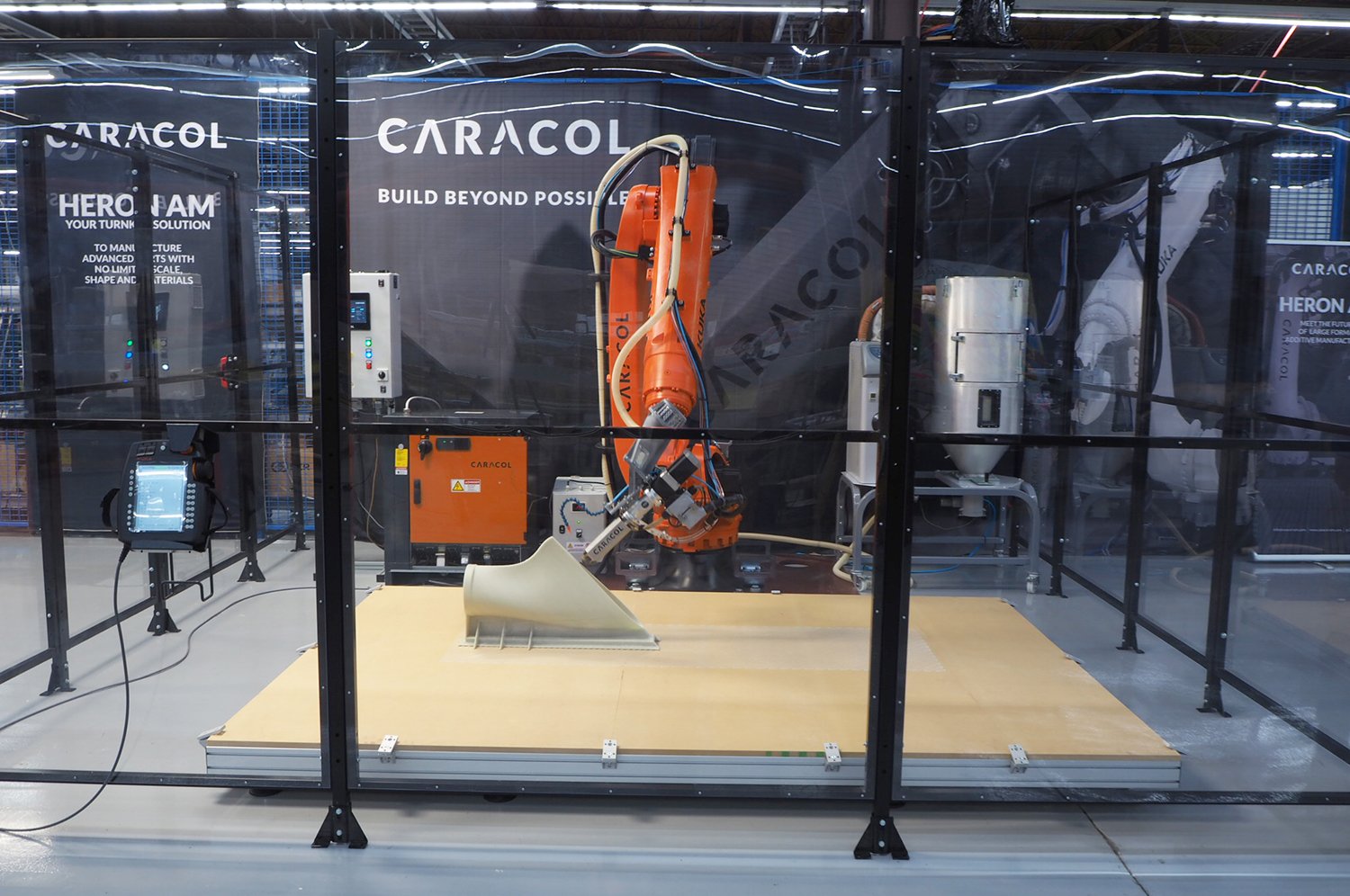
Instead of 3D printing small prototype parts, Caracol’s robotic systems manufacture large-scale marine structures, molds, and functional components for boats and yachts. Rather than relying on traditional tooling or moulds, Caracol’s systems manufacture parts layer by layer directly from digital designs, helping companies reduce waste, lower production costs, and accelerate manufacturing timelines. Its core sectors today are transportation (including dual defence applications across maritime, aerospace, and land mobility), creative industries like architecture, construction, retail environments, and design applications using sustainable materials and customised geometries. The company launched a metal additive manufacturing platform around two years ago, expanding into energy applications, including propulsion systems, industrial components, and nuclear-related applications. The company is also exploring solutions for manufacturing in space. In maritime composite manufacturing, producing a component traditionally involves several months of lead time. It can take three to four months just to create the mould, then several more weeks to laminate and finish the part. Caracol eliminates the mold entirely. De Stefano detailed:
This not only saves time but also money. A project with yacht makers Ferretti Group achieved cost savings of more than 30 per cent. The benefits also extend to waste reduction. In conventional aerospace tooling, traditional manufacturing often wastes 70 to 80 per cent of the material during machining. With Caracol, waste drops to below 5 per cent. Caracol’s process also leads to significant weight reduction. In some cases, tooling components are now one-tenth the weight of traditional alternatives, making them much easier to move and manage in factories. Building a transatlantic manufacturing footprintThe company is currently the only large-format additive manufacturing player operating manufacturing facilities in both Europe and the US. According to De Stefano, Caracol made this decision early in recognition of how important the US market would become, particularly for aerospace, defence, and industrial manufacturing. In the US, manufacturers have historically relied more on very large and expensive gantry systems. Flexible robotic manufacturing is gaining momentum there now as companies increasingly understand the importance of deployable, localised manufacturing. Comparing the two markets, De Stefano said: “Interestingly, Europe is actually more advanced in robotics integration than parts of the US. I think that comes from Europe’s industrial heritage and manufacturing traditions. “One major difference is that US customers are generally faster to adopt new technology. There is less resistance from a mindset perspective and more willingness to take risks. At the same time, expectations around support and responsiveness in the US are much higher:
From supervised machines to autonomous manufacturingAutomation within large-scale additive manufacturing has evolved rapidly over the past decade, shifting from highly supervised production environments toward increasingly autonomous and self-optimising systems. De Stefano describes progress in the sector as “dramatic”. In 2017, the company’s systems required constant oversight. “Operators had to supervise the machines continuously and manually intervene throughout the process.” Today, he explained, “Caracol’s systems can operate lights-out for days at a time. Once the print is launched, the machine can run autonomously with very minimal intervention.” While there is still some manual work involved in setting up prints, loading materials, and post-processing parts, AI and machine learning are increasingly automating those operations as well. The next stage is machines becoming capable of understanding and optimising their own processes in real time. The company already has its Nexus software platform, which monitors large amounts of production data.
To support that vision, Caracol built its own integrated hardware, software, and automation ecosystem designed to centralise manufacturing intelligence across its global network. De Stefano explained: “All our systems connect through the Nexus platform, which allows us to aggregate and analyse production data globally. That means the machines are effectively learning from one another already. For Caracol, what began as an effort to “break the box” of traditional 3D printing has evolved into a broader vision of distributed, software-driven manufacturing systems. Its long-term ambition is not just autonomous machines, but globally connected manufacturing systems capable of collectively learning and improving over time. Rather than robots directly ‘talking’ to each other individually, the learning happens through a centralised data and software layer. The more data we gather across the network, the faster the systems improve collectively. “That’s really the long-term vision: globally connected manufacturing systems continuously learning and optimising together,” shared De Stefano. |
14/05/2026 10:10 AM | 1 | |
| 54,945 | 14/05/2026 09:30 AM | Ten Years In, VivaTech Is Just Getting Started [Sponsored] | ten-years-in-vivatech-is-just-getting-started-sponsored | 14/05/2026 | When VivaTech first opened its doors in 2016, it gathered 45,000 visitors. This June, the 10th edition is expected to welcome more than 180,000 attendees from 171 countries, a 300% increase that reflects not just the event's growth, but the pace of transformation reshaping the global tech landscape. From 17 to 20 June at Paris Expo Porte de Versailles, VivaTech 2026 promises to be its most ambitious edition yet: 15,000 startups, 4,000 investors, 1,500+ live demos, and a program built around the questions that actually matter right now, AI and productivity, cybersecurity and defense, the energy transition, and the frontier technologies redefining what's scientifically possible. Here's a look at some of the conversations and speakers you won't want to miss. The Energy Transition Gets RealThe climate debate at VivaTech 2026 moves past ambition and into execution. The Energy, Greentech & Mobility track tackles the uncomfortable math behind decarbonization: can renewables scale fast enough? Can AI be sustainable when data centers are consuming energy at record rates? Who pays for electrification and who profits? To answer these questions, VivaTech is bringing together some of the sector's most consequential voices. Lei Zhang, CEO of Envision, one of the world's leading renewable energy and smart energy companies, will be at VivaTech alongside Philippe Piron, CEO of Electrification at GE Vernova, the energy technology spin-off now at the center of the global grid modernization effort. François Provost, CEO of Renault, will represent the mobility side of the equation at a moment when the European automotive industry is navigating one of its most complex strategic pivots. Rounding out the track: Siddarth Singh, Co-lead of Energy and AI at the International Energy Agency, and Kate Williams, CEO of 1% for the Planet, bringing both data-driven rigour and accountability frameworks to a conversation that needs both. On the floor, startups like Nyobolt (ultra-fast charging), Bienesis (climate-resilient agriculture), and Tenaka (ocean regeneration, world exclusive) will demonstrate that the energy transition isn't a future story. It's shipping now. Tech Beyond the ObviousIf one track captures why VivaTech still surprises after a decade, it's Tech Beyond the Obvious, dedicated to deeptech, radical science, and the innovations that seem implausible until suddenly they aren't. Jerry Chow, IBM Fellow and CTO for Quantum-Centric Supercomputing at IBM, will be at VivaTech to present the "quantum chandelier", a world exclusive demonstration of a system capable of computations that classical computers simply cannot perform, with applications in healthcare, telecommunications, and industrial optimization. On the space side, Helene Huby, Founder and CEO of The Exploration Company, represents a new generation of European private space ventures redefining what independent orbital infrastructure looks like. And Madeline Lawrence, Chief Growth Officer of Aikido, speaks to a parallel frontier: AI-assisted tools that detect and fix code vulnerabilities at the speed the threat landscape now demands. The track also features Adel Haddoud, CEO of Infinite Orbits, working on satellite life-extension technology, and world exclusives including Xpanceo's AI-powered smart contact lens capable of projecting information directly into the field of vision. Where Tech Leadership Gets TestedThe Tech Leaders Summit, powered by QuantumBlack AI by McKinsey, Nebius and Orisha, is where the conversation shifts from what's possible to what's actually hard. CTOs, CIOs, CISOs, and CDOs gather to work through the tensions that don't resolve neatly on a slide deck: how do you harden cybersecurity while accelerating deployment? Where does digital sovereignty end and operational paranoia begin? When every layer of the stack is becoming intelligent, who actually controls it? The speaker lineup reflects the stakes. Elizabeth Stone, Chief Technology Officer at Netflix, brings the perspective of an organization that has made infrastructure a competitive advantage, and must now navigate what AI-native product development means at global scale. Jens Holtinger, CTO of Volvo Group, represents an industry in the middle of one of its most complex technological transitions: electrification, software-defined vehicles, and autonomous systems converging simultaneously. Damien Lucas, CEO of Scaleway, speaks from the front line of European cloud sovereignty, a question that has moved from policy debate to operational urgency. And Thomas Dohmke, Founder & CEO of Entire, brings a builder's perspective on what it actually takes to modernize enterprise infrastructure from the inside. At a time when cyberattacks surged 75% in a single year (Accenture, 2024) and AI is simultaneously the most powerful tool available to defenders and attackers alike, this forum is less a conference track and more a pressure test for tech leadership in real conditions. A New Format, A New AudienceVivaTech 2026 also marks two firsts in the event's history. On 14 June, three days before the main event, VivaTech will take over the Champs-Élysées for a free, public-facing day of innovation, pedestrianizing one of the world's most iconic avenues and transforming it into an open showcase for AI, robotics, mobility, health, and climate tech. On 20 June, the general public day becomes the VivaTech Festival, opening the event's final day to 18-35-year-olds, with programming focused on AI & Society, the Creator Economy, and career opportunities in tech, including a dedicated Careers Festival and exclusive demos. Join VivaTech from June 17 to 20 at Paris Porte de Versailles. Book now at vivatech.com, before the robots do. |
14/05/2026 10:10 AM | 1 | |
| 54,950 | 14/05/2026 09:20 AM | The EU-Startups Podcast | Interview with Pieterjan Bouten, Founding and Managing Partner at Entourage | the-eu-startups-podcast-or-interview-with-pieterjan-bouten-founding-and-managing-partner-at-entourage | 14/05/2026 |
He also shares insights on his role as an Entrepreneur in Residence at the Vlerick Entrepreneurship Academy and the vision behind Wintercircus, a hub for entrepreneurs, researchers, and digital creatives. Pieterjan dives into the challenges and triumphs of scaling a global SaaS company, the evolution of his perspective as both an operator and investor, and how Entourage is redefining early-stage support for European founders. He also discusses the future of AI in B2B SaaS, the role of communities like Wintercircus, and what it takes for founders to stand out in today’s competitive landscape. Key Points
 This episode of the EU-Startups Podcast is brought to you by Vanta. The trust management platform helps more than 12k companies, including Nando’s, Allica Bank and Granola, start and scale their security programmes while building trust with buyers. It saves security teams time and improves programme visibility by automating over 35 compliance frameworks, such as SOC 2 and ISO 27001, as well as GRC workflows like risk management. Click here to learn more! This episode of the EU-Startups Podcast is brought to you by Vanta. The trust management platform helps more than 12k companies, including Nando’s, Allica Bank and Granola, start and scale their security programmes while building trust with buyers. It saves security teams time and improves programme visibility by automating over 35 compliance frameworks, such as SOC 2 and ISO 27001, as well as GRC workflows like risk management. Click here to learn more!
The post The EU-Startups Podcast | Interview with Pieterjan Bouten, Founding and Managing Partner at Entourage appeared first on EU-Startups. |
14/05/2026 11:10 AM | 6 | |
| 54,946 | 14/05/2026 09:18 AM | Samsung wants its union back at the table. The union wants the bonus formula in writing. | samsung-wants-its-union-back-at-the-table-the-union-wants-the-bonus-formula-in-writing | 14/05/2026 | 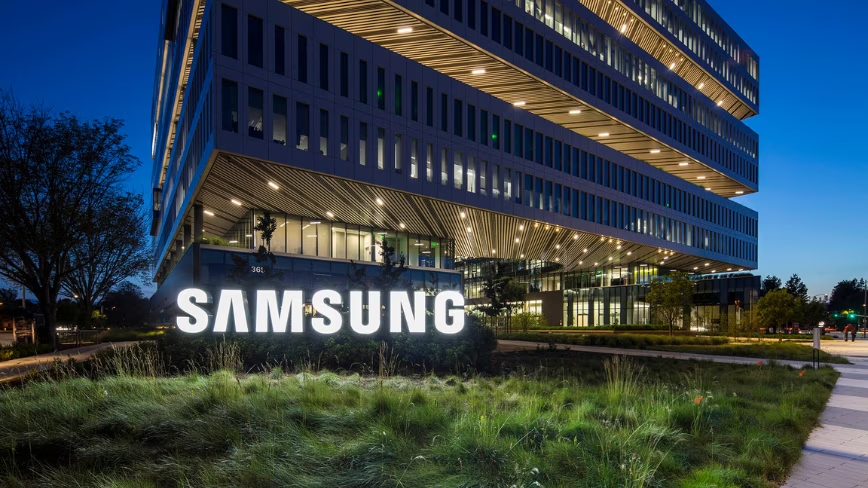 A week after Samsung Electronics passed $1tn in market value, its largest union is preparing an 18-day strike that could disrupt the AI memory chips inside that valuation. The wage gap with SK Hynix is the spark. The bonus formula is the fight. Samsung Electronics sent a letter to its two largest unions on Thursday […] This story continues at The Next Web |
14/05/2026 10:10 AM | 3 | |
| 54,935 | 14/05/2026 09:01 AM | London fintech Banked acquired by Australia’s top business lender | london-fintech-banked-acquired-by-australias-top-business-lender | 14/05/2026 | A London-founded payments fintech backed by US investment giant Bank of America has been acquired by Australia’s top business lender, the lender has announced. Banked, founded in London in 2018, has built technology which allows users to pay online from their bank accounts, as opposed to using a credit or debit card. The payment method is known as account-to-account payments. The fintech has been acquired by National Australia Bank (NAB) for an undisclosed sum, with Banked boss Brad Goodall saying the deal will allow its tech to reach more people. Banked, which is backed by Bank of America, Insight Partners and Citi, has raised over $50m in funding rounds. NAB is an existing customer of Banked, which has offices in London, Palo Alto and Vilnius, and has also invested in Banked via its venture arm. Sources told Tech.eu that Banked would now be exiting the UK and US market and focus on Australia. NAB executive Shane Conway said: “Pay by Bank is part of a broader shift in Australia’s payments landscape toward real‑time, account‑to‑account options that sit alongside cards and digital wallets. Customers expect making payments to be fast, easy and reliable, and Banked helps us deliver that.” Goodall, Banked CEO and co-founder, said: “The Banked team have worked hard to build a globally proven payments platform focused on the modern demands of developers and merchants of all sizes and scale. Having the backing of NAB will allow the platform to reach more customers.” Earlier this year, Tech.eu reported that Banked’s proposed acquisition of UK fintech VibePay did not go through, despite a press release announcing the deal last year. Sources said the deal failed due to issues arising out of the due diligence process carried out by Banked. |
14/05/2026 09:10 AM | 1 | |
| 54,934 | 14/05/2026 09:00 AM | The hidden costs of hiring freelancers across borders — and how to avoid them | the-hidden-costs-of-hiring-freelancers-across-borders-and-how-to-avoid-them | 14/05/2026 | 14/05/2026 08:10 AM | 5 | ||
| 54,941 | 14/05/2026 09:00 AM | Meta’s New Reality: Record High Profits. Record Low Morale | metas-new-reality-record-high-profits-record-low-morale | 14/05/2026 | Next week, Meta is cutting about 10 percent of its staff. WIRED spoke with more than a dozen current and former employees about what it's like inside a company where "everyone is unhappy." | 14/05/2026 09:10 AM | 4 | |
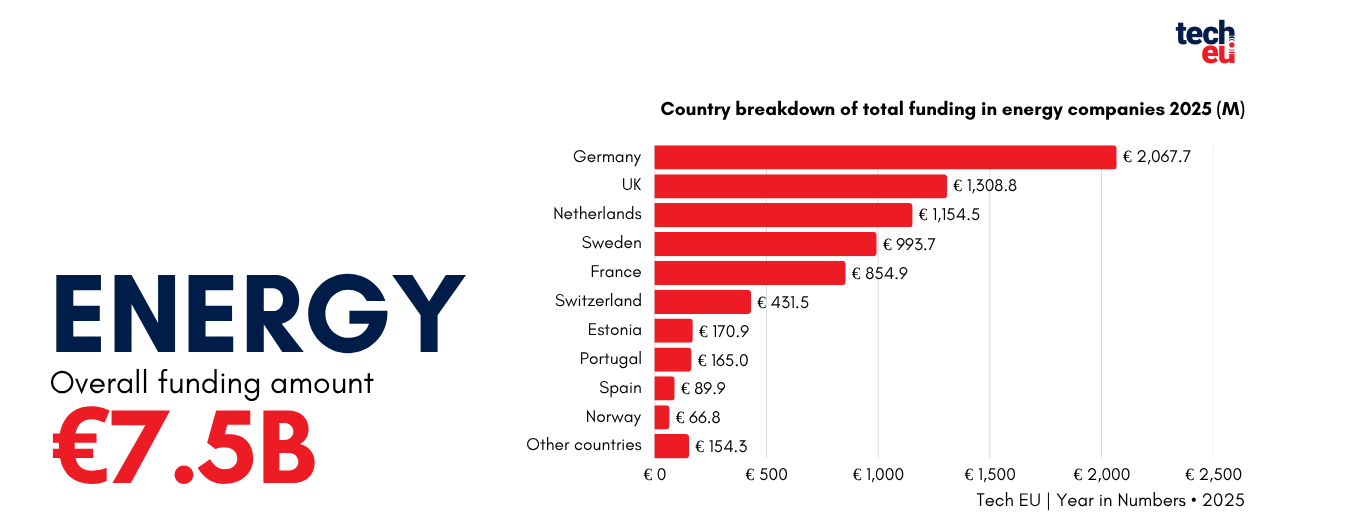
| 54,936 | 14/05/2026 09:00 AM | Energy tech: 10 companies that raised the most in 2025 | energy-tech-10-companies-that-raised-the-most-in-2025 | 14/05/2026 | In 2025, European energy tech companies raised €7.5 billion, with funding concentrated in large infrastructure-focused rounds spanning EV charging, battery storage, grid flexibility, home energy systems, and sustainable fuels. Debt financing played a major role, particularly among companies scaling capital-intensive assets such as charging networks and storage systems. Germany, the UK, the Netherlands, France, and Sweden stood out among the most active markets. The largest deals show investor focus on deployment-ready infrastructure, with EV charging companies IONITY, Electra, and Believ ranking highly, while battery and grid storage companies, including Green Flexibility, Zenobē, Lion Storage, Return, and Energy Vault, also attracted significant capital.
Overall, 2025 points to a European energy tech market increasingly shaped by scale, infrastructure buildout, and the need to support electrification and renewable energy integration (for more detailed analyses of the European technology ecosystem, check out Tech.eu’s annual report: EuropeanTech 2025 - The Big Picture). Here are ten energy tech companies that raised the most in 2025
|
14/05/2026 09:10 AM | 1 | |
| 54,947 | 14/05/2026 08:55 AM | SK Hynix is about $50bn away from being a trillion-dollar company | sk-hynix-is-about-dollar50bn-away-from-being-a-trillion-dollar-company | 14/05/2026 |  Two AI memory rallies, one country, and a market cap chart that has gone up 9x in two years. If SK Hynix crosses the threshold, South Korea becomes the first country outside the US to host two trillion-dollar companies at the same time. SK Hynix is roughly $50bn away from a trillion-dollar market capitalisation. Its […] This story continues at The Next Web |
14/05/2026 10:10 AM | 3 | |
| 54,951 | 14/05/2026 08:52 AM | Prague’s Zerops raises €1.7 million to close the gap between development and production in cloud infrastructure | pragues-zerops-raises-euro17-million-to-close-the-gap-between-development-and-production-in-cloud-infrastructure | 14/05/2026 | Zerops, a Prague-based platform-as-a-service startup redesigning cloud architecture, has raised a €1.7 million ($2 million) Seed round led by Gi21 Capital to expand its global infrastructure in the US and Asia, accelerate product development, and grow its team. The funding will support expansion into Asia and North America, including scaling infrastructure in the United States and opening a new data centre in Singapore. Damir Špoljarič, founder of Gi21 Capital, said, “The market is reaching an inflection point. Rising cloud costs are forcing a shift, while AI is changing not just how software is written, but who is building and running it. We’re moving from millions of developers to millions of developers working alongside AI agents. Most platforms weren’t designed for either of these changes. Zerops was. Its economics come from owning the full stack, and its architecture works because it never abstracts away the underlying infrastructure.” The company notes that developing and managing software in the cloud remains both complex and expensive. It cites Gartner’s forecast that global cloud expenditure will hit €617.5 million ($723 billion) by 2025, but highlights that developers devote just 16% of their time to coding, while the remaining effort is spent on infrastructure and tools. According to Zerops, a core issue is that development and production environments are fundamentally different, so applications that work in one often fail in the other. “At the same time, simpler platforms abstract away critical system visibility, while more powerful solutions require significant operational expertise. The rise of AI coding tools is adding further strain, with 45% of developers reporting that debugging AI-generated code takes more time than writing it themselves, often because this code is built in environments that do not match real systems,” mentioned the company in the press release. Zerops claims to create a unified environment where applications behave identically from development through to production, enabling reliable deployments from the start. It states that on its platform, there are no environment tiers; applications run within a single project where code behaves the same way, regardless of scale. This means developers build, test, and deploy in genuinely identical conditions, eliminating an entire category of deployment failures. The startup points out that because the infrastructure is consistent from the start, deploying a production-ready system requires a single click, not weeks of configuration. Zerops is built on its own infrastructure, with data centres across Europe and the United States. It runs applications in full Linux containers, not restricted app containers, giving developers the same level of access as on their own machines, including real-time visibility and control over running processes. The platform also includes more than 15 built-in services such as databases, search engines, and messaging systems, reducing the need for external integrations compared to the typical two or three offered by most platforms. As applications grow, they remain within a single environment, removing the need to re-architect infrastructure at scale, says Zerops. Aleš Rechtorík, co-founder and CEO of Zerops, said, “Most platforms ask you to trust that development and production are close enough. We removed the gap entirely by rethinking how cloud architecture should work from the ground up. That’s the same guarantee we now give AI coding agents, and it’s why the code they produce is production-ready from the first deployment. What works once continues to work as applications scale. Our goal is to make running software predictable, not something teams have to constantly debug.” The company is also introducing Zerops Control Panel (ZCP), a feature designed for AI-driven development. ZCP connects AI coding agents, such as Claude, Codex, or Gemini, directly to real cloud infrastructure within a Zerops project, enabling them to build, deploy, and debug applications in real-world conditions rather than in isolated environments. Since AI operates within the same environment as production, the generated code functions immediately. Developers can work alongside AI in the same workspace, reviewing and modifying outputs with their preferred tools. Zerops aims to become one of the primary cloud platforms used by developers globally, focusing on delivering infrastructure that balances control, transparency, and cost, for both human developers and AI agents. The post Prague’s Zerops raises €1.7 million to close the gap between development and production in cloud infrastructure appeared first on EU-Startups. |
14/05/2026 11:10 AM | 6 | |
| 54,948 | 14/05/2026 08:35 AM | Cerebras raises $5.55bn in the biggest US tech IPO since Snowflake | cerebras-raises-dollar555bn-in-the-biggest-us-tech-ipo-since-snowflake | 14/05/2026 |  Priced at $185, above the marketed range, the wafer-scale chip company opens trading on Thursday at a $56.4bn valuation. The OpenAI deal is what got the book covered. The customer concentration footnote is what the next quarter has to answer. Cerebras Systems priced its IPO at $185 per share on Wednesday evening, above the marketed […] This story continues at The Next Web |
14/05/2026 10:10 AM | 3 | |
| 54,937 | 14/05/2026 08:20 AM | This memory chip works at 700 degrees Celsius. The startup behind it is already building AI chips that compute where GPUs cannot. | this-memory-chip-works-at-700-degrees-celsius-the-startup-behind-it-is-already-building-ai-chips-that-compute-where-gpus-cannot | 14/05/2026 |  Every probe humanity has sent to Venus has died. The Soviet Venera landers survived between 23 minutes and two hours on a surface where the temperature exceeds 460 degrees Celsius. Their electronics, designed to endure heat that would melt lead, still failed. The longest-lived mission in the history of Venus exploration lasted 127 minutes. […] This story continues at The Next Web |
14/05/2026 09:10 AM | 3 | |
| 54,938 | 14/05/2026 08:20 AM | OpenAI says no user data was touched in the TanStack npm worm | openai-says-no-user-data-was-touched-in-the-tanstack-npm-worm | 14/05/2026 |  Two corporate laptops, some credential material, and a forced macOS app update. The interesting part is how the malicious packages got published in the first place: not by a stolen npm password, but by TanStack’s own legitimate release pipeline, after the attacker code took over the runner mid-build. OpenAI said on Wednesday that it found […] This story continues at The Next Web |
14/05/2026 09:10 AM | 3 | |
| 54,939 | 14/05/2026 08:06 AM | Microsoft is quietly shopping for an OpenAI replacement | microsoft-is-quietly-shopping-for-an-openai-replacement | 14/05/2026 |  The company that put $13bn into OpenAI now wants the option not to need it. Cursor was the first try and fell apart over GitHub Copilot; talks with Stanford diffusion-LLM startup Inception are alive, and the broader strategy belongs to Mustafa Suleyman. Reuters reported on Wednesday, citing five people familiar with the matter, that the […] This story continues at The Next Web |
14/05/2026 09:10 AM | 3 | |
| 54,932 | 14/05/2026 08:00 AM | Zerops raises $2M seed to rebuild cloud infrastructure for the AI development era | zerops-raises-dollar2m-seed-to-rebuild-cloud-infrastructure-for-the-ai-development-era | 14/05/2026 | Zerops, a Platform-as-a-Service startup redesigning cloud architecture, has raised a $2 million seed round led by Gi21 Capital. Zerops removes the separation between development and production environments, a long-standing flaw in cloud architecture that causes deployment failures for developers and AI coding agents alike. It creates a unified environment where applications behave identically from development through to production, enabling reliable deployments from the start. On Zerops, there are no environment tiers; applications run within a single project where code behaves the same way, regardless of scale. This means developers build, test, and deploy in genuinely identical conditions, eliminating an entire category of deployment failures. Because the infrastructure is consistent from the start, deploying a production-ready system requires a single click, not weeks of configuration. It runs applications in full Linux containers, not restricted app containers, giving developers the same level of access as on their own machines, including real-time visibility and control over running processes. The platform also includes more than 15 built-in services such as databases, search engines, and messaging systems, reducing the need for external integrations compared to the typical two or three offered by most platforms. As applications grow, they remain within a single environment, removing the need to re-architect infrastructure at scale.
Because AI operates in the same environment used for production, the code it produces works from the start. Developers can collaborate with AI within the same workspace, reviewing and modifying outputs using their own preferred tools.
The new funding will be used to expand Zerops’ global infrastructure in the US and Asia, accelerate product development, and grow its team. |
14/05/2026 08:10 AM | 1 | |
| 54,940 | 14/05/2026 07:41 AM | US clears H200 sales to 10 Chinese firms, but not a single chip has shipped | us-clears-h200-sales-to-10-chinese-firms-but-not-a-single-chip-has-shipped | 14/05/2026 |  Washington has approved Alibaba, Tencent, ByteDance, JD.com, and six others to buy Nvidia’s H200, with each licence good for up to 75,000 units. Beijing has told its tech sector to wait, and Jensen Huang has now been added to Trump’s Beijing trip to try to break the deadlock. The US has cleared roughly 10 Chinese […] This story continues at The Next Web |
14/05/2026 09:10 AM | 3 | |
| 54,942 | 14/05/2026 07:31 AM | How Malta’s Nomad Residence Permit is helping professionals build beyond borders (Sponsored) | how-maltas-nomad-residence-permit-is-helping-professionals-build-beyond-borders-sponsored | 14/05/2026 | For a growing number of nomads, Malta is emerging as more than a temporary destination for remote work. It is becoming a place where professionals can build with greater stability, connect with like-minded innovators, enjoy island life, and put down longer-term roots. What starts as a move to maintain a flexible and global profession and lifestyle may turn into something more permanent. Non-EU founders, consultants, tech specialists and remote entrepreneurs are arriving in Malta through the Nomad Residence Permit, drawn by the practical advantages of a Mediterranean hub that is safe, English-speaking, digitally advanced and strategically connected. Some then discover something unexpected: Malta is not just a great place to live while building globally, it is a place to grow from. A Mediterranean base with business substanceThis is because Malta combines lifestyle with substance. Yes, there is the sun, sea and quality of life, but what resonates with startup-minded professionals is the business-friendly environment behind it. Nationwide 5G, strong banking infrastructure, co-working ecosystems, access to European, African and Middle Eastern markets, and a time zone that makes it convenient to collaborate with global teams and reach clients across regions all make Malta a highly functional operating base. For founders and remote operators, this matters. Increasingly, nomads arriving with established ventures or scalable services are using Malta as more than a temporary stop. They are building networks, forming partnerships and, in some cases, transitioning from remote entrepreneurs into startup operators with deeper roots on the island. What begins as location independence can, for some, evolve into location advantage. From remote work to deeper rootsSince launching the Nomad Residence Permit in 2021, Malta has focused on attracting globally mobile professionals who can contribute to a growing digital and entrepreneurial ecosystem. The shift from nomad to operator happens organically. This has been evident in co-working and networking sessions organised by Residency Malta Agency, where conversations often move quickly from remote work to collaboration, partnerships and even business creation. For some, Malta begins as a remote-work base and evolves into a launchpad for longer-term ventures. Support for founders ready to scaleMalta offers regulatory stability, efficient digital public services and streamlined administration, factors often underestimated until you have experienced the alternatives. For startup founders used to friction, that ease of execution is a competitive advantage. There is also increasing support for those looking to scale. Through entities such as Malta Enterprise and Trade Malta, founders can tap into grants, growth support and internationalisation pathways that make Malta attractive not only as a base for living, but for building. And perhaps that is Malta’s real differentiator vis-à-vis other nomad destinations: it offers a credible pathway from remote work to long-term opportunity. A pathway into Malta’s startup ecosystemWhile early-stage entrepreneurs might not yet be ready to submit a business plan via the Malta Startup Residence Programme, they may choose to first relocate through the Nomad Residence Permit, using their time in Malta to understand the local ecosystem, build connections and validate their business concept before transitioning once their venture is operational. The Nomad Residence Permit grants eligible non-EU nationals a one-year residence permit:
For those looking for more than a temporary setup, Malta can offer a place where business, community and quality of life come together, and one that is hard to leave. A stay in Malta that starts with the Nomad Residence Permit may well become your next strategic base in Europe. Learn more and apply for Malta’s Nomad Residence Permit at nomad.residencymalta.gov.mt. For details about the Malta Startup Residence Programme click here The post How Malta’s Nomad Residence Permit is helping professionals build beyond borders (Sponsored) appeared first on EU-Startups. |
14/05/2026 09:10 AM | 6 | |
| 54,933 | 14/05/2026 07:12 AM | DDD Invoices raises €1.31M to simplify global e-invoicing compliance | ddd-invoices-raises-euro131m-to-simplify-global-e-invoicing-compliance | 14/05/2026 | DDD Invoices, a Ljubljana-based company building API-driven infrastructure for global e-invoicing compliance, has raised a €1.31 million seed round backed by Fil Rouge Capital, 500 Global, and experienced operators from the ERP and e-invoicing ecosystem. The company is also supported by angel investors and advisors from the e-invoicing and ERP ecosystem, including former executives and founders from IFS, Pagero, Tickstar, Arratech, and Docupath. As governments increasingly mandate real-time e-invoice reporting to local tax portals, businesses and software providers face growing compliance complexity. Different countries apply their own formats, validation rules, and submission requirements, creating costly and fragmented integrations for companies operating across markets. DDD Invoices is building an API-first infrastructure designed to simplify this process. Through a unified API, the company connects ERPs, accounting systems, and SaaS platforms to tax portals, Peppol networks, and real-time reporting systems worldwide. Its platform automates the issuing, receiving, and archiving of tax-compliant e-invoices across jurisdictions while ensuring compliance with local Continuous Transaction Control (CTC), e-invoicing, and fiscalization requirements. The company uses proprietary AI-driven logic to transform standardised invoice data into local formats, validate invoices against current regulations, route them to the relevant tax systems, and return status information to the originating application. For unstructured files such as PDFs, DDD Invoices also applies AI-based document processing to extract and structure invoice data automatically. Denis Vehovec Pondelak, CEO and co-founder of DDD Invoices, said modern software companies are increasingly challenged by local compliance complexity as they scale across markets.
Founded by a team with more than 30 years of experience building business software, including ERP systems for public and private institutions, DDD Invoices is already working with companies such as Access Group, Zenoti, Logitude, and WheelSys across multiple global markets. The platform also offers native integrations with systems including Stripe, Bitrix, Shopify, and Chargebee. With the new funding, DDD Invoices plans to expand its country coverage, accelerate deployment and integration capabilities, and grow its product, engineering, and go-to-market teams. |
14/05/2026 08:10 AM | 1 | |
| 54,943 | 14/05/2026 06:38 AM | Swedish EnergyTech startup Elvy closes €5.9 million round after securing €500 million credit facility | swedish-energytech-startup-elvy-closes-euro59-million-round-after-securing-euro500-million-credit-facility | 14/05/2026 | Stockholm-based EnergyTech company Elvy has closed a €5.9 million ($7 million) round to accelerate growth and establish Elvy’s subscription model as the market standard for homeowners across Europe. The round was led by Essential Capital and Daft Capital, with participation from Mathias Kamprad and other angel investors. Last December, the company secured €500 million from Scayl, a Swedish debt-funding platform. Elvy notes that this credit facility is already in place, with funds earmarked for hardware deployment at scale. Alongside the raise, business leader and investor Knut Frängsmyr, with roles at Klarna, Epidemic Sound, and Qred Bank, joins the company as Chairman of the Board. “Sweden is facing an electricity crisis, and new nuclear plants are over a decade away. Elvy has already built the technology needed for a stable Swedish energy system and low electricity costs for households. Together with our partners, we are ready to invest over €1 billion and secure 600 MW within three years,” said CEO Johan Outinen. Founded in 2023 by Johan Outinen and David Wedar, Elvy provides fully integrated home energy solutions, including solar panels, heat pumps, and battery systems. It offers an energy package consisting of hardware, installation, maintenance and the houses’ electricity needs, at a fixed monthly subscription. The company owns the hardware and claims to take full operational responsibility across the 15-year contract. According to Elvy, the package is managed by its proprietary AI engine to control and optimise the energy generated and consumed by the households. Elvy reported that its subscription model grew 10x in 2025. In just over 18 months, the company has built 23 MW of capacity in its distributed energy park across the country. “Our solution is different from anything else on the market, because it’s simple. With an Elvy subscription, you don’t need to worry about whether there’s no wind in Germany when you want to cook or do laundry. With the financing in place, we now have the resources to bring our service to every home in Sweden,” the Swedish company mentioned in the press release. The post Swedish EnergyTech startup Elvy closes €5.9 million round after securing €500 million credit facility appeared first on EU-Startups. |
14/05/2026 09:10 AM | 6 | |
| 54,930 | 14/05/2026 06:00 AM | Software engineering’s bottleneck is no longer code | software-engineerings-bottleneck-is-no-longer-code | 14/05/2026 |  For most of the history of software, planning was sacred. You had to plan before anyone touched a keyboard, because the cost of building the wrong thing could be so punishing, especially for startups, that getting it right upfront was the only rational strategy. Implementation was expensive, engineering time was scarce, and changing direction once […] This story continues at The Next Web |
14/05/2026 07:10 AM | 3 | |
| 54,929 | 14/05/2026 05:24 AM | Clio’s $500M milestone arrives just as Anthropic ups the ante | clios-dollar500m-milestone-arrives-just-as-anthropic-ups-the-ante | 14/05/2026 | 14/05/2026 06:10 AM | 7 | ||
| 54,931 | 14/05/2026 05:01 AM | Slovenia’s DDD Invoices secures €1.31 million to tackle fragmented global e-invoicing compliance | slovenias-ddd-invoices-secures-euro131-million-to-tackle-fragmented-global-e-invoicing-compliance | 14/05/2026 | DDD Invoices, a Ljubljana-based company building API-driven infrastructure for global e-invoicing compliance, has closed a €1.31 million Seed round supported by Fil Rouge Capital, 500 Global, and experienced operators from the ERP and e‑invoicing ecosystem. The company plans to use this funding to expand country coverage, streamline integrations and deployment, and grow the team across product, engineering, and go-to-market. “Modern software companies cannot afford to be slowed down by local compliance complexity. Compliance is already not the most exciting part of building a company, but now it is becoming increasingly more complex due to governments tightening the regulations and companies scaling globally from the get-go. We’re building the infrastructure to take that off their plate,” said Denis Vehovec Pondelak, CEO and co-founder of DDD Invoices. Founded in 2023, DDD Invoices provides a unified API that connects business and financial SaaS platforms to tax portals worldwide to ensure that every invoice transmitted is compliant with local CTC (Continuous-Transactions-Control), e‑invoicing, and fiscalisation requirements automatically. According to the Slovenian startup, invoicing was once a straightforward process between two businesses. However, in many countries, invoices now need to go through government tax portals or networks like Peppol and undergo real-time validation before they are legally recognised and delivered to the recipient. It states that each country defines its own formats, validation rules, and submission logic. For software vendors serving customers across multiple markets and for fast-growing companies operating through multiple entities, this results in a fragmented, costly system of country-by-country integrations. DDD Invoices claims to abstract this complexity through a unified API for issuing, receiving, and archiving tax‑compliant e‑invoices, offering an “all‑encompassing” solution for modern scaling. Companies submit standardised invoice data, which DDD Invoices converts into local formats. It then validates the data against current rules, routes it to the appropriate tax system, and provides status updates back to the original application. For companies using platforms such as Stripe, Bitrix, Shopify, and Chargebee, DDD Invoices states that it offers native integrations. For unstructured files such as PDFs, the company uses AI‑based document processing to extract and structure invoice data. Roger Blott, partner at Fil Rouge Capital, said, “Fully compliant e-invoicing is a necessity in commerce today, and DDD is at the centre of providing this essential service to its customers. Globally, these services are in their infancy, but in a short time, they will become ubiquitous, and DDD has a second-to-none solution. We are looking forward to participating in DDD’s successful and exciting growth story.” Today, DDD Invoices supports software companies such as Access Group, Zenoti, Logitude, and WheelSys in various global markets. The company is also supported by angel investors and advisors with long‑standing experience in e‑invoicing, ERP, and Peppol‑based infrastructure. They include Bengt Nilsson (founder of IFS, former CEO of Pagero), Hans Berg (co‑founder of Tickstar and CEO of Arratech), Oscar Wegland (former CMO at Pagero, co‑founder and CMO of Docupath), Alexander Jansson (former Head of partnerships at Pagero, COO at Docupath), and Carl Julius Nilsson (former CCO at Pagero, CEO of Docupath). The post Slovenia’s DDD Invoices secures €1.31 million to tackle fragmented global e-invoicing compliance appeared first on EU-Startups. |
14/05/2026 07:10 AM | 6 | |
| 54,927 | 14/05/2026 05:00 AM | Exclusive: The secretive group recruiting whistleblowers to shake up the VC industry | exclusive-the-secretive-group-recruiting-whistleblowers-to-shake-up-the-vc-industry | 14/05/2026 | 14/05/2026 04:10 AM | 5 | ||
| 54,928 | 14/05/2026 05:00 AM | Exclusive: H Company cofounder steps down as CTO | exclusive-h-company-cofounder-steps-down-as-cto | 14/05/2026 | 14/05/2026 04:10 AM | 5 |