Switch Dataset:
Startup News
We are collecting the most relevant tech news and provide you with a handy archive. Use the search to find mentions of your city, accelerator or favorite startup in the last 1,000 news items. If you’d like to do a more thorough search, please contact us for help.
Search for any keyword to filter the database with >10,000 news articles
Filter
Filter search
Results
| id | date | title | slug | Date | link | content | created_at | feed_id |
|---|---|---|---|---|---|---|---|---|
| 58,655 | 20/10/2026 11:37 AM | Qualcomm reportedly plans global job cuts after annual staff reviews | qualcomm-reportedly-plans-global-job-cuts-after-annual-staff-reviews | 20/10/2026 |  Qualcomm plans to cut jobs around the world after its yearly staff reviews, with affected employees due to be told from November. Chief executive Cristiano Amon set out the plan to staff on Monday, according to an internal memo seen by Reuters. The memo calls the move a “performance-focused reduction” but gives no number of jobs. Reuters […] This story continues at The Next Web |
20/10/2026 12:10 PM | 3 | |
| 58,656 | 20/10/2026 11:27 AM | Microsoft adds EU access oversight and offline AI to its sovereign cloud | microsoft-adds-eu-access-oversight-and-offline-ai-to-its-sovereign-cloud | 20/10/2026 |  Microsoft is adding new controls to its sovereign cloud for governments and regulated companies, the CEO Satya Nadella announced today. The changes give customers more say over who can reach their systems, and let them run more AI tools on their own hardware. Today in Paris, we announced new capabilities across Microsoft Sovereign Cloud, expanding […] This story continues at The Next Web |
20/10/2026 12:10 PM | 3 | |
| 58,651 | 20/10/2026 11:09 AM | EIT launches €40M funding call to help bring university deep tech research to market | eit-launches-euro40m-funding-call-to-help-bring-university-deep-tech-research-to-market | 20/10/2026 | The European Institute of Innovation and Technology (EIT) has launched a new call to strengthen the capacity of higher education institutions to turn their research into innovations focused on the manufacturing and deep tech areas. the EIT Higher Education Initiative aims to help universities develop innovation and entrepreneurship skills, turn research into commercial products, and build stronger links with businesses. Backed by €40 million from the EIT, the 2026 funding round will offer up to €1.25 million per selected project over 18 months. Universities, businesses, research organisations, public bodies, and other partners are invited to apply together. The selected projects will help universities develop practical innovation and entrepreneurship skills among students and staff, particularly in STEM, manufacturing, and deeptech. They will also help universities turn research into commercial products, better manage intellectual property, and share expertise. With support from the EIT’s Knowledge and Innovation Communities (KICs), universities will build stronger connections with businesses, investors, and the wider startup community. Martin Kern, Director of the EIT, said:
Natalie Walsh, Project Coordinator, Idea to Impact (i2i), a beneficiary of a previous call, said:
Each consortium must include at least five funded partners: at least three HEIs (from three different Horizon Europe-eligible countries, including at least one EU Member State), and at least two business/industry partners and/or business/industry representative organisations (e.g., SMEs, startups, larger enterprises, industry associations); industry partners that operate in manufacturing or deep-tech technologies are strongly encouraged to join a consortium. Consortia have until 13 January 2027 17:00 (CET) to submit their applications. Selected projects will be announced later in 2027. |
20/10/2026 11:10 AM | 1 | |
| 58,650 | 20/10/2026 11:00 AM | ‘The true barrier to entry is scale’: Inside the new frontier of European fintech’s AI arms race | the-true-barrier-to-entry-is-scale-inside-the-new-frontier-of-european-fintechs-ai-arms-race | 20/10/2026 | 20/10/2026 10:10 AM | 5 | ||
| 58,652 | 20/10/2026 10:51 AM | AstraZeneca and Oracle team up on AI to find patients for drug trials | astrazeneca-and-oracle-team-up-on-ai-to-find-patients-for-drug-trials | 20/10/2026 |  AstraZeneca and Oracle will use AI and real patient health data to find people for drug trials faster, the two firms announced. The deal adds to a long list of AI health tie-ups between drugmakers and tech companies. The pair signed a non-binding term sheet, so the terms are not yet final, and neither firm said or […] This story continues at The Next Web |
20/10/2026 11:10 AM | 3 | |
| 58,653 | 20/10/2026 10:37 AM | Google Cloud outage hits London region as Revolut also goes down | google-cloud-outage-hits-london-region-as-revolut-also-goes-down | 20/10/2026 |  Dozens of Google Cloud services failed in the company’s London data centre region on Tuesday morning, and hit firms that run their systems there. The same morning, customers of fintech Revolut could not use its app or pay by card. A person familiar with the matter told Reuters that Revolut’s outage was related to the Google Cloud […] This story continues at The Next Web |
20/10/2026 11:10 AM | 3 | |
| 58,654 | 20/10/2026 10:11 AM | Amazon plans to make a €16bn investment in Germany in 2027 | amazon-plans-to-make-a-euro16bn-investment-in-germany-in-2027 | 20/10/2026 |  Amazon plans to invest more than €16 billion ($18 billion) in Germany in 2027, expanding its cloud computing, AI, logistics, satellite internet, and TV production businesses. The company announced the investment today at the Invest in Germany Summit in Berlin. The two-day event, hosted by Chancellor Friedrich Merz, aims to attract investment to the country. […] This story continues at The Next Web |
20/10/2026 11:10 AM | 3 | |
| 58,642 | 20/10/2026 09:58 AM | Revolut app down in widespread outage | revolut-app-down-in-widespread-outage | 20/10/2026 | 20/10/2026 09:11 AM | 5 | ||
| 58,647 | 20/10/2026 09:45 AM | Nscale and Anthropic reportedly in talks over second $45bn deal | nscale-and-anthropic-reportedly-in-talks-over-second-dollar45bn-deal | 20/10/2026 |  Nscale is negotiating to sell Anthropic about $45bn more in AI computing capacity, two months after the two companies agreed to a deal of the same size. Bloomberg reported the talks, citing people familiar with the matter. A deal could be signed within days, although the terms may still change. Both companies declined to comment […] This story continues at The Next Web |
20/10/2026 10:10 AM | 3 | |
| 58,648 | 20/10/2026 09:30 AM | Daytona CEO Ivan Burazin says it grows 51% a month with no salespeople | daytona-ceo-ivan-burazin-says-it-grows-51percent-a-month-with-no-salespeople | 20/10/2026 |  Daytona runs sandboxes for AI agents, co-founder and chief executive Ivan Burazin told TNW. Its users include Meta, Cohere and Handshake, and the company has about 30 employees. Burazin, a Croatian citizen, started Daytona with two co-founders, one of whom he has worked with for almost 20 years. Before Daytona, he co-founded Codeanywhere, a cloud […] This story continues at The Next Web |
20/10/2026 10:10 AM | 3 | |
| 58,646 | 20/10/2026 09:16 AM | Silent sailing, noisy generators: Hydrogen startups PowerUP and H2Boat tackle yachting's diesel problem | silent-sailing-noisy-generators-hydrogen-startups-powerup-and-h2boat-tackle-yachtings-diesel-problem | 20/10/2026 | PowerUP Energy Technologies, the Estonian company renowned for its advanced hydrogen fuel cell-based electric generators, today announced a strategic partnership with H2Boat, an Italian marine hydrogen technology startup developing integrated solutions for onboard hydrogen production, storage, and use. Check out our earlier interview with PowerUP CEO Ivar Kruusenberg. The partnership aims to give yacht owners and shipyards a practical pathway to quieter, cleaner onboard energy systems by combining complementary technologies to deliver a complete, integrated zero-emission energy solution. H2Boat, a spin-off from the University of Genoa, brings core expertise in marine hydrogen systems and proprietary metal hydride storage technology. Its solutions are engineered for on-board integration, addressing a key challenge for hydrogen in the maritime sector: storing hydrogen safely and efficiently in a form compatible with the constraints of recreational and professional vessels. The joint solution is designed to eliminate vibrations, noise, and greenhouse gas emissions, returning only pure water to the environment in a perfect circular-economy application. "As a lifelong sailor, I know firsthand the absolute peace of being out on the open water, completely in tune with nature. It's like a guillotine dropping when you start a diesel generator," said Dr Ivar Kruusenberg, CEO and Founder of PowerUP Energy Technologies.
The partnership combines H2Boat’s expertise in onboard hydrogen production, metal hydride storage, and marine system integration with PowerUP’s proton exchange membrane (PEM) fuel cell generators. Together, the companies aim to deliver an integrated system that produces hydrogen from renewable electricity, stores it safely on board, and converts it back into quiet, emission-free electricity for maritime use. "By partnering with PowerUP, we can offer our customers an increasingly complete and integrated hydrogen energy solution, from production and storage through to clean electricity generation on board," said Thomas Lamberti, CEO of H2Boat.
Beyond onboard technology, H2Boat is also developing local hydrogen production and refilling solutions with well-known maritime clients in the Ligurian area and near the Swiss-Italian border, helping build the infrastructure needed to support the adoption of hydrogen-powered marine applications. |
20/10/2026 10:10 AM | 1 | |
| 58,649 | 20/10/2026 09:16 AM | OpenAI reportedly races to close $30bn round before Anthropic’s IPO | openai-reportedly-races-to-close-dollar30bn-round-before-anthropics-ipo | 20/10/2026 |  OpenAI is trying to speed up a funding round of about $30bn to secure investor commitments before Anthropic lists its shares in mid-November. The round could value the ChatGPT maker at more than $ 1.4 trillion. Reuters reported the plan on Monday, citing two people familiar with the matter. OpenAI and SoftBank declined to comment […] This story continues at The Next Web |
20/10/2026 10:10 AM | 3 | |
| 58,636 | 20/10/2026 09:02 AM | Nvidia invests in four German startups as part of $10BN European investment pledge | nvidia-invests-in-four-german-startups-as-part-of-dollar10bn-european-investment-pledge | 20/10/2026 | Nvidia is investing in four German startups, it said yesterday, as part of a multi-billion-dollar investment across Europe, as the chip maker’s charm offensive across the continent continues. The US chip maker is investing in AI robotics startup Agile Robots, AI healthtech startup Avelios Medical, AI audio startup Mirelo and space technology startup Reflex Aerospace. Nvidia is an existing investor in German startups n8n and Black Forest Labs. The four new investments, for an undisclosed size, follow recent startup investments Nvidia has announced in France and the UK, as its CEO and co-founder Jensen Huang takes part in a whirlwind tour of Europe, which also included a visit to Sweden. The investments are part of a nearly $10bn investment by Nvidia across European tech, investing in startups, universities, and research institutions, as Nvidia looks to maintain momentum behind AI by investing across the ecoystem. The new investments were announced as Huang visited Germany, speaking to German chancellor Friedrich Merz about Germany’s AI roadmap and the industrial applications of AI. The conversation focused on how Germany can make the most of the AI revolution by playing to its strengths in manufacturing and automotive. Nvidia and Germany also announced a joint venture to advocate cutting-edge AI models for physical AI while Nvidia announced a flurry of other deals with German partners, including Siemens and Mercedes-Benz.
|
20/10/2026 09:10 AM | 1 | |
| 58,637 | 20/10/2026 08:51 AM | Coherence Quantum raises €2.78M to tackle quantum computer scaling challenges | coherence-quantum-raises-euro278m-to-tackle-quantum-computer-scaling-challenges | 20/10/2026 | Finnish quantum hardware startup Coherence Quantum has raised €2.78 million in a seed funding round to develop its cryogenic signalling and control technology for quantum computers. The round was led by Lifeline Ventures, with participation from technology entrepreneur Mårten Mickos. Originating from Aalto University’s Quantum Computing and Devices (QCD) research group, Coherence Quantum is developing an integrated cryogenic signalling and control platform designed to address infrastructure challenges associated with scaling quantum processors. As quantum computers become more powerful, increasing the number of qubits also requires more complex control and readout systems. Conventional approaches involve additional wiring and signal-conditioning hardware within environments with limited space and cooling capacity, while quantum processors must remain protected from thermal noise and other disturbances that can affect performance. Coherence Quantum aims to address these challenges by developing technologies that improve signal conditioning and enable more efficient connections between control systems and quantum processing units. Aashish Sah, CEO and co-founder of Coherence Quantum, explained that scaling quantum computers requires not only increasing the number of qubits but also developing the infrastructure needed to support them. He said:
The company's technology builds on research conducted at Aalto University, where its team has spent more than two years developing and testing cryogenic signalling and control systems. This work has included multiple generations of prototypes, with testing carried out in dilution refrigerators using qubit systems. With the new funding, Coherence Quantum plans to establish a laboratory in Espoo, Finland, develop its first product prototypes and manufacturing processes, continue research and development, and expand its team. In the longer term, the company aims to contribute to the development of a standardised architecture for cryogenic signalling and control systems, combining its own technology with complementary solutions from the wider quantum ecosystem. |
20/10/2026 09:10 AM | 1 | |
| 58,640 | 20/10/2026 08:50 AM | Revolut outage leaves customers unable to use app or cards | revolut-outage-leaves-customers-unable-to-use-app-or-cards | 20/10/2026 |  Revolut customers across Europe were unable to open the fintech’s app or pay with their cards on Tuesday morning, after a service disruption hit several of its features. Outage tracker Downdetector logged more than 1,500 reports at that point, and users in the UK, France, Romania and Spain said they could not move money, while […] This story continues at The Next Web |
20/10/2026 09:11 AM | 3 | |
| 58,638 | 20/10/2026 08:38 AM | Blackwall hits $2.2B valuation with $100M Series C just weeks after joining Estonia's unicorn club | blackwall-hits-dollar22b-valuation-with-dollar100m-series-c-just-weeks-after-joining-estonias-unicorn-club | 20/10/2026 | Web traffic management platform Blackwall today announced it has raised $100 million in Series C at a valuation of $2.2 billion. Last month it was reported that Blackwall reached a €1 billion valuation and ranked fifth in TopTech 2026, the annual ranking of Estonia's 30 most valuable tech companies. AVP led the round, with participation from existing investors Dawn Capital, MMC Ventures and Tera Ventures. By connecting providers, infrastructure and technology, Blackwall aims to provide greater control over how internet traffic is managed, secured and monetised. Currently spanning bot mitigation, DDoS protection, web application firewall, load balancing, server-side encryption and management of agentic AI traffic, which is rapidly taking over the Internet, Blackwall is deployed inside the web hosting providers’ own infrastructure, identifying real visitors and legitimate automated traffic from malicious bots, attacks and traffic abuse, filtering billions of requests per day. Blackwall partners with web hosting, managed service and cloud providers that run much of the web. Hosting is a $200 billion market, and a fragmented one, because infrastructure has to stay close to the businesses it serves; for most of the web, the provider is the only route to a site at scale. Unlike the hyperscale and content-delivery platforms that compete with providers for their own customers, Blackwall sits inside the provider's infrastructure and strengthens the relationship between the provider and the businesses it hosts.
Norman Fiore, General Partner at Dawn Capital, commented:
Blackwall will use the investment to scale its global presence across the web traffic management market, establishing and expanding operations across 12 strategic regions spanning North America, Europe, Asia-Pacific and the Middle East. |
20/10/2026 09:10 AM | 1 | |
| 58,641 | 20/10/2026 08:22 AM | Micron workers in Taiwan to strike as bonus talks with chipmaker fail | micron-workers-in-taiwan-to-strike-as-bonus-talks-with-chipmaker-fail | 20/10/2026 |  Micron workers in Taoyuan, Taiwan, are set to go on strike on Thursday, 22 October, after months of failed negotiations over how the US chipmaker shares its profits with employees. The union announced the planned walkout on Monday, Reuters reported. It has not said how long the strike will last, but promised to provide more […] This story continues at The Next Web |
20/10/2026 09:11 AM | 3 | |
| 58,639 | 20/10/2026 08:20 AM | Ganiga secures €2.5M to expand its AI-powered food waste technology | ganiga-secures-euro25m-to-expand-its-ai-powered-food-waste-technology | 20/10/2026 | Italian deeptech startup Ganiga has raised €1.5 million in an equity funding round to further develop its AI-powered waste management technology and support commercial expansion. The round was led by Italian contract catering company Vivenda, with participation from London-based NextSTEP and three angel investors. Together with €1 million secured through Smart&Start Italia, an incentive programme managed by Invitalia, Ganiga's total funding has reached €2.5 million. Founded in the province of Pisa by Nicolas Zeoli, Ganiga develops technologies combining artificial intelligence, computer vision and robotics to improve waste management and reduce food waste. The company initially focused on robotic waste sorting, developing devices that identify and separate different types of waste. It has sold more than 300 devices for use in airports, shopping centres and large businesses across Italy, Japan, Australia and other European countries. Building on data collected through these deployments, Ganiga expanded into food waste management with HooolyFood, an AI-powered system designed to help catering operators monitor and reduce waste. Using cameras installed above waste containers, the system identifies discarded food without requiring weighing and provides data to help operators identify inefficiencies, improve purchasing and menu planning, and manage costs. Developed in less than a year, the technology is already deployed in operations serving more than 30,000 meals daily. The company's proprietary data platform brings information from its devices into a single dashboard to analyse waste patterns, estimate costs and monitor container fill levels. Ganiga is also extending its technology to automate ingredient ordering and menu planning, while developing sensors for existing containers to monitor municipal and other waste streams. The development comes as the European Union introduces binding targets to reduce food waste by 2030. According to Eurostat, the EU generated approximately 58 million tonnes of food waste in 2023, highlighting the need for more efficient waste management across industries, including food services. Nicolas Zeoli, founder and CEO of Ganiga, said the investment will help scale technology already deployed in commercial settings. He added:
With the new funding, Ganiga plans to expand its technical and commercial teams, further develop HooolyFood and its data platform, and increase recurring revenue. The company will initially focus on expanding within contract catering alongside Vivenda, before targeting event catering, hotels and other foodservice settings. |
20/10/2026 09:10 AM | 1 | |
| 58,643 | 20/10/2026 08:03 AM | London’s Emerald secures €1.66 million to scale its preventive healthcare platform | londons-emerald-secures-euro166-million-to-scale-its-preventive-healthcare-platform | 20/10/2026 | Emerald, a London-based preventive healthcare platform, has secured an additional €1.66 million (£1.4 million/$1.85 million) in funding. This brings the company’s total funding to date to €3.44 million (£2.9 million). The latest funding includes an €832.2k (£700k) grant from Innovate UK, Emerald’s second award from the organisation, together with a further €832.2k (£700k) in venture capital investment secured after the award. All existing investors, along with new backers including Sequel and Highgoal, supported the round, and Emerald’s valuation increased from its previous funding round. Alexander Badalyan, co-founder and CEO of Emerald, explained, “There’s huge demand for access to simple healthcare tools that move beyond just testing. People want to understand what those results mean and the steps they can take to boost their long-term health – informed by guidance from trusted medical experts. “A preventative approach to healthcare significantly improves long-term health outcomes by providing a more holistic view of a patient’s health, highlighting potential issues before they become critical, and empowering people to enter the right pathway earlier. “Achieving this ambition is a cornerstone of the current Government’s current health agenda – but the NHS cannot deliver this shift alone. Government efforts must be matched with innovative solutions that are able to have widespread reach. Emerald has unlocked access to millions of potential users through its partnerships – with ambitions to become the UK’s go-to platform for long-term health management. This additional funding allows us to build on the demand we’re already seeing, deepen these partnerships, and expand care.” Founded in 2024, Emerald says its platform combines in-clinic laboratory screening with a digital platform that brings results, wearable data and health history together in one place. This approach helps members identify potential health risks earlier and empowers them to take control of their long-term health. Explaining its differentiating factor, Emerald notes that traditional health checks capture one moment in time, whereas the UK startup connects comprehensive testing with users’ past results, lifestyle, and wearable data to reveal patterns, priorities, and changes. It further notes that every member is paired with a GP who can diagnose, prescribe, and make formal referrals into both private and NHS care where appropriate. The company highlighted that it is clinician-founded and Care Quality Commission registered, offering regulated activities including diagnostic and screening procedures and treatment of disease, disorder or injury. The platform is also authorised as a UKCA Class I medical device with the MHRA. Since the beginning of 2026, the company reported that it has grown its member base tenfold and has now processed more than 100k laboratory tests, with repeat-screening data. According to the startup, this data highlights improvements in cholesterol levels for two out of three users, blood sugar levels dropping by a third, and reduced inflammation amongst members dropping by almost half. In January this year, the company announced the closure of its €1.78 million ($2 million) pre-Seed round. Emerald also mentioned that it has significantly expanded its clinical capabilities and, over the last 12 months, it has announced partnerships with Pluxee, Epassi, Yonder and other businesses across the employee benefits, FinTech and fitness sectors to scale its offering. With this approach, the company intends to enable employers to include its services as part of their existing benefits offering. Chris Sawyer, Innovation Lead, Digital Health at Innovate UK, said, “Connecting earlier health insights with appropriate care is an important opportunity for healthcare innovation in the UK. Through this award, we are supporting Emerald’s development of AI-enabled technology designed to help clinicians deliver more personalised, proactive care. We look forward to seeing the project progress and the impact it could have on health outcomes.” The company plans to use this additional funding to support commercial expansion and further development of its products and clinical services as the platform aims to reach one million members over the next three years. The Innovate UK grant will specifically support the expansion of Emerald’s AI applications and underlying technology, with the aim of improving healthcare outcomes across the UK. The post London’s Emerald secures €1.66 million to scale its preventive healthcare platform appeared first on EU-Startups. |
20/10/2026 09:11 AM | 6 | |
| 58,634 | 20/10/2026 07:30 AM | Former Google CEO Eric Schmidt reportedly owns about 1% of Anthropic ahead of its IPO | former-google-ceo-eric-schmidt-reportedly-owns-about-1percent-of-anthropic-ahead-of-its-ipo | 20/10/2026 |  Eric Schmidt, Google’s former CEO, owns about 1% of Anthropic, according to Bloomberg. If the AI company goes public at the valuations now being discussed, the stake could be worth billions of dollars. Schmidt invested tens of millions of dollars in Anthropic’s Series A round in 2021, Bloomberg reported, citing people familiar with the matter. […] This story continues at The Next Web |
20/10/2026 08:10 AM | 3 | |
| 58,635 | 20/10/2026 07:12 AM | Germany signs AI partnership with Nvidia at Berlin investment summit | germany-signs-ai-partnership-with-nvidia-at-berlin-investment-summit | 20/10/2026 |  At the Invest in Germany Summit in Berlin, the German government entered into an agreement with Nvidia on Monday, when Chancellor Friedrich Merz opened the two-day event by addressing Jensen Huang, Nvidia’s CEO. The economy ministry has entered into a memorandum of understanding with the chipmaker but has provided no further details; the agreement comes […] This story continues at The Next Web |
20/10/2026 08:10 AM | 3 | |
| 58,644 | 20/10/2026 07:01 AM | London-based “Surgical Intelligence” company XRlabs raises €7.48 million to bring AI into the operating room | london-based-surgical-intelligence-company-xrlabs-raises-euro748-million-to-bring-ai-into-the-operating-room | 20/10/2026 | XRlabs, the London-based Surgical Intelligence company built by surgeons for surgeons, has raised €7.48 million ($8.4 million) in Seed funding. The round was led by Playground Global, the DeepTech-focused venture firm based in Palo Alto, with participation from London-based HealthTech investor Eka Ventures. Alongside the fundraise, XRlabs also announced that Omar Ishrak, who led Medtronic as Chairman and CEO from 2011 to 2020 and previously served as chairman of Intel’s board, has joined as Chair of its Board of Directors. “The best physical AI companies come from people who’ve experienced a problem in their field firsthand and have the deep expertise to know how to fix it,” said Bruce Leak, General Partner at Playground Global. Founded by practising neurosurgeon Dr. Ali Haddad in 2024, XRlabs is headquartered in London at the London Institute for Healthcare Engineering, with a second office in Palo Alto, California. The company develops modular, device-agnostic software that sits as an external AI layer across the surgical systems hospitals already own. Its platform uses computer vision and deep learning to transform live video from surgical scopes, navigation telemetry, and pre-operative CT and MRI imaging into a single real-time, anatomy-aware view of each procedure. XRlabs says its platform has been deployed across more than 100 surgical cases on three continents. The company offers two core products: XRlabs SIM and SurgicalOS. The XRlabs SIM is a patient-specific planning and rehearsal tool that transforms standard CT and MRI scans into interactive 3D reality models or digital twins, while SurgicalOS is an intraoperative intelligence layer that brings the digital twin created in SIM into the live operative view. The XRlabs SIM and SurgicalOS together form what the company describes as “Pyramid of Surgical Intelligence,” a layered approach to building AI surgical understanding that mirrors how surgeons are trained, starting from anatomy and building toward real-time operative skill. “Our conviction is that the operating room is the next frontier for physical AI. Surgery generates extraordinary data, yet almost none of it becomes intelligence in the moments that matter most. This financing lets us change that at scale, moving Surgical Intelligence from landmark first cases to foundational infrastructure in every operating room,” said Dr. Haddad, founder and CEO of XRlabs. The funding comes on the back of major clinical achievements, including first-in-human use of physical AI in cranial neurosurgery, integrated with an ORBEYE 4K 3D exoscope under research conditions and a world-first in AI-designed patient-specific implants, used in the successful separation of craniopagus twins. XRlabs says it will use the Seed funding to support the buildout of its engineering and clinical teams, advance its products through regulatory pathways in the UK, Europe, and the US, while extending the clinical evidence base at partner institutions globally. The company has also been awarded a compute allocation on the UK AI Research Resource (AIRR), the UK’s national AI compute infrastructure, which supports the development and scaling of its AI capabilities. The post London-based “Surgical Intelligence” company XRlabs raises €7.48 million to bring AI into the operating room appeared first on EU-Startups. |
20/10/2026 09:11 AM | 6 | |
| 58,633 | 20/10/2026 06:46 AM | Former Google DeepMind top researcher launches London “compute-efficient” AI company | former-google-deepmind-top-researcher-launches-london-compute-efficient-ai-company | 20/10/2026 | A London-based AI company co-founded by a former Google DeepMind research lead and AlphaGo co-creator is launching today, pursuing a “compute-efficient” alternative path to Anthropic and OpenAI’s frontier AI models in progressing AI. Thore Graepel, who left Google DeepMind this summer, is launching AI company Metis Reasoning, which is understood to be initially raising tens of millions of dollars, marking the latest AI company springing up out of London. Graepel, who is a co-creator of AlphaGo, an AI programme developed by Google DeepMind which made history by defeating human players at the Chinese board game of Go, and his co-founders have put together a 12-strong team. The team is made up of researchers, mathematicians, robotics experts and tech entrepreneurs to pursue a different approach to AI reasoning, the process whereby an AI system works through a problem, connecting information, rather than producing an answer based on learning patterns. The launch of Metis (named after the Greek goddess of reasoning and wisdom), which believes its thesis will lend itself well to industries such as robotics and engineering, comes as investors pour millions into alternative AI systems to LLMs. Metis’s founding team is Graepel; Piers Ingram, a serial technology and biotech entrepreneur who has raised more than $350m; Michael Warren, robotics and autonomous systems expert with experience at Boeing; and David Berman, head of AI at Cambridge Consultants and a UK government and NATO AI advisor. Metis argues that LLMs have made significant progress and can often generate fluent answers, infer meaning, follow instructions and perform some multi-step tasks. But Metis argues that LLMs have a fundamental limitation in how they reason and can be unreliable and lack an audit trail. Metis argues that this is a barrier to wider AI adoption, saying its adoption in many industries remains constrained by the difficulty of verifying its work. Ingram, who met Graepel at a Cambridge barbecue where they chatted about Turing machines, says: “When you think about higher-stakes cases in engineering or science, or medical or legal reasoning, the arguments that the models come up with basically can’t be trusted. I don’t think that’s a good foundation for what we want our AI to be.” Metis’s thesis builds on Graepel's work at AlphaGo, saying that a similar architectural lesson should be applied to AI reasoning. Metis argues its approach is more verifiable, robust and safer than current frontier models. Asked why Anthropic and OpenAI were not pursuing a similar path to Metis, Ingram said: "I think they are thinking about it differently.” Ingram would not comment on reports that Metis was raising tens of millions of dollars, but said: "We have been able to fund the company more than adequately to date.” He said that Metis’s architecture was “much much more” compute efficient than frontier models. He said: “We are very much not going in this direction of ever larger models and ever larger training budgets." He said Metis had “achieved” some “encouraging” results in frontier reasoning problems at a fraction of the cost of frontier models. It is unclear when Metis will publicly launch its first AI model. Metis is joining other new London-based AI companies, including Ineffable Intelligence, founded by Graepel's former AlphaGo colleague David Silver; and Recursive Superintelligence, co-founded by high-profile German computer scientist Richard Socher. Asked if there was any overlap between Metis and Ineffable and Recursive, Ingram said: “We obviously don’t know exactly what they are doing; they don’t know exactly what we are doing.” But added that he thought Metis’s approach was “really a very different, almost philosophical approach”. |
20/10/2026 07:10 AM | 1 | |
| 58,645 | 20/10/2026 06:01 AM | Copenhagen’s Plinto raises €2.9 million to help finance teams catch and fix errors with AI agents | copenhagens-plinto-raises-euro29-million-to-help-finance-teams-catch-and-fix-errors-with-ai-agents | 20/10/2026 | Plinto, a Copenhagen-based startup building AI for real-time controlling, has secured €2.9 million in pre-Seed funding. The round was led by People Ventures and Emblem, with participation from a group of business angels. “Companies have systems that record every single transaction, but checking whether those transactions actually match agreements and rules is still largely manual. We’re building AI agents that find deviations, investigate them and take action, so errors get fixed,” said Jakob Nielsen, co-founder and CDO of Plinto. Plinto was founded in early 2025 by Nermina Suljevic, Nielsen, and Sebastian Rehnby, who previously worked for Peakon, the employee engagement platform acquired by US-based Workday in 2021. The company’s CTO Andreas Garnæs is also an alumnus of Peakon. Together, they bring experience across product development, engineering, commercial scaling, and working with large international organisations. In large organisations, the volume of financial transactions exceeds what finance teams can review manually. This work is handled by controllers, who typically resort to spot checks or end-of-month reconciliations, leaving enough room for errors such as incorrect prices, duplicate invoices, or mismatched deliveries. Plinto wants to solve this problem with AI agents that sit on top of the systems companies already use, such as ERP, documents, bank, and collaboration tools like Slack or Microsoft Teams. When a transaction is flagged, Plinto’s agents are designed not only to alert someone but also to investigate, gather evidence, and follow up with relevant people within the organisation and external contacts. Plinto says the agents are capable of contacting a supplier about a wrongful invoice, requesting a credit note or preparing a correction for approval. It says one of its customers uncovered around 430 deviations per month in a single part of the business. At another customer, the agents identified a duplicate invoice submitted with a different supplier name in the same minute it arrived. “Many of our customers work with low margins, so even small errors can quickly add up. The problem is that they’re often only discovered after the money has been paid. We want companies to catch and fix errors before they hit the bottom line,” said Suljevic, co-founder and CEO of Plinto. Plinto platform integrates with major ERP platforms, including Microsoft Business Central, Xero, and Visma, and connects to major Scandinavian banks as well as over 2,700 other banks. It counts paying customers and pilots in logistics, real estate, facility services, and food production. The platform covers both order-to-cash and procure-to-pay workflows, and all data is processed and stored within the EU. Plinto also says it never uses customer data to train AI models. The company plans to use the pre-Seed funding for product development, bringing on more enterprise customers and making Plinto’s first move outside Denmark. It wants to bring its agents to enterprises beyond its home market and aims to help them find financial errors in real time. The post Copenhagen’s Plinto raises €2.9 million to help finance teams catch and fix errors with AI agents appeared first on EU-Startups. |
20/10/2026 09:11 AM | 6 | |
| 58,632 | 20/10/2026 06:00 AM | Exclusive: Coherence Quantum raises €2.78M to cut the heat inside quantum computers | exclusive-coherence-quantum-raises-euro278m-to-cut-the-heat-inside-quantum-computers | 20/10/2026 | 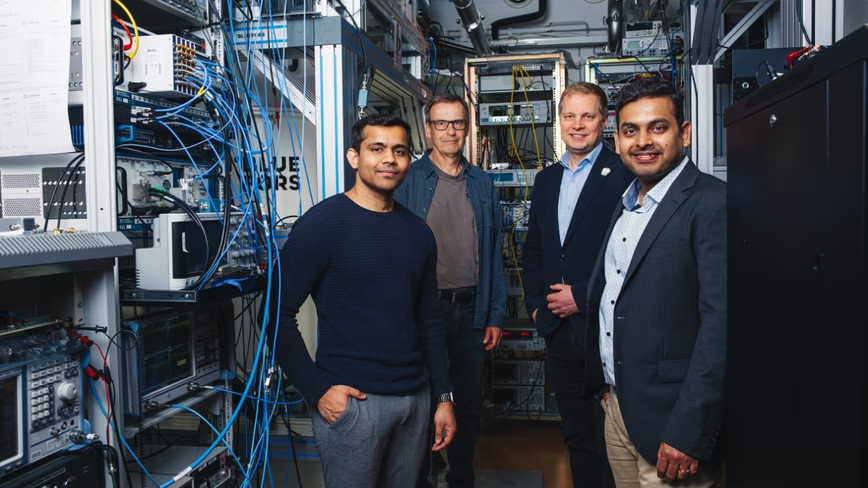 Think of a quantum computer as a very delicate machine that needs to operate in extreme cold. The processor is the part that does the actual computing, but it needs a lot of supporting equipment to work. The processor sits inside a special refrigerator that cools it to temperatures close to absolute zero. Cables run […] This story continues at The Next Web |
20/10/2026 06:10 AM | 3 |