Switch Dataset:
Startup News
We are collecting the most relevant tech news and provide you with a handy archive. Use the search to find mentions of your city, accelerator or favorite startup in the last 1,000 news items. If you’d like to do a more thorough search, please contact us for help.
Search for any keyword to filter the database with >10,000 news articles
Filter
Filter search
Results
| id | date | title | slug | Date | link | content | created_at | feed_id |
|---|---|---|---|---|---|---|---|---|
| 56,770 | 15/09/2026 12:21 PM | MP calls for scrutiny of AI Security Institute as fears grow | mp-calls-for-scrutiny-of-ai-security-institute-as-fears-grow | 15/09/2026 | 15/09/2026 12:10 PM | 5 | ||
| 56,766 | 15/09/2026 11:56 AM | EveryCarbon wins FLAIR subcontract to scale fossil-independent materials production | everycarbon-wins-flair-subcontract-to-scale-fossil-independent-materials-production | 15/09/2026 | EveryCarbon, a high-performance shielding materials company developing engineered polyester systems for demanding industrial and construction environments, today announced it has been awarded a subcontract under the FLAIR project, led by Technische Universität Hamburg (TU Hamburg), to scale its circular diol production process from laboratory development to a 10,000-litre (10 m³) industrial pilot at Popp Feinkost. EveryCarbon has engineered high-performance polyester ECOne, developed initially for performance insulation in demanding building environments and industrial manufacturing applications. Scaling from laboratory to industrial pilot is one of the most demanding steps in bringing a new materials platform to market. The project is designed to demonstrate that EveryCarbon's production process can integrate directly into existing industrial infrastructure — reducing both the capital cost and the time required to reach industrial scale, while supporting the kind of supply resilience that increasingly matters to industrial and construction buyers exposed to volatile, fossil-derived supply chains. The subcontract sits within FLAIR — Funktionsmaterialien aus Lebensmittelabfällen durch prozess-Integriertes Recycling (Functional Materials from Food Waste through Process-Integrated Recycling) — a multi-year initiative converting food-processing side-streams into high-value functional materials through process-integrated recycling. The project will follow a staged scale-up pathway. First, EveryCarbon will support retrofitting an existing 10 m³ tank to enable waste hydrolysis at Popp Feinkost's facility, integrating the fermenter with the site’s existing gas infrastructure and hot water supply systems, and preparing the system for continuous operation. Once the industrial fermentation system is operational, EveryCarbon will transport the food waste hydrolysate produced at Popp Feinkost to its pilot facility in Stuttgart. EveryCarbon will then further convert the waste hydrolysate to ECOne engineering resins. Partners at Hamburg University of Technology and the University of Hamburg will develop new monomers and polymers derived from the platform. Central to the project is its data layer, developed by Fraunhofer IPA, that will enable the early prediction of new material applications and significantly shorten development cycles. According to Sebastian Beblawy, Chief Executive Officer and Co-Founder of EveryCarbon, deploying a 10,000-litre fermentation process is a major step toward proving that existing industrial infrastructure is a key to unlocking the next fossil-independent manufacturing layer. “This project allows us to validate continuous production of the building block used in ECOne, while showing how existing industrial infrastructure can be repurposed to reduce dependence on fossil-derived materials.” Prof. Johannes Gescher, Head of the Institute of Technical Microbiology, TU Hamburg, said:
|
15/09/2026 12:10 PM | 1 | |
| 56,768 | 15/09/2026 11:42 AM | Some prop firms profit from failure | some-prop-firms-profit-from-failure | 15/09/2026 |  The appeal of prop trading starts with a genuine problem around access to capital. 45% of people who don’t invest said they simply did not have enough money to do so. Talented traders lack enough capital to turn skill into returns. Proprietary firms are an alternative. They give capable traders the opportunity to manage substantially […] This story continues at The Next Web |
15/09/2026 12:10 PM | 3 | |
| 56,767 | 15/09/2026 11:29 AM | Einride and Lidl deploy Germany’s first driverless cab-less truck on public roads | einride-and-lidl-deploy-germanys-first-driverless-cab-less-truck-on-public-roads | 15/09/2026 | Cab-less trucking company Einride and German food retailer Lidl – a company of Schwarz Group –- today announced the deployment of the first cab-less SAE Level 4 autonomous truck in daily operations on a public road in Germany. An SAE Level 4 autonomous truck can drive itself without human intervention within defined operating conditions, such as specific routes, roads, or weather conditions. Unlike lower levels of automation, it does not require a driver to take over if something goes wrong; within its approved operating domain, the automated system is responsible for the driving task. The cab-less truck, with no driver or safety operator on board, is now transporting goods between a Lidl warehouse and distribution centre and a Lidl store, operating under an official permit from the Federal Motor Transport Authority (KBA), the first of its kind granted in Germany. Germany, the world’s third-largest economy and the largest road transport market in Europe, has some of the world's most stringent road safety regulations. The permit reflects an extensive safety validation process conducted with the KBA, confirming that the technology can operate reliably and safely under real-world conditions on public roads. For Einride and Lidl, it is also a step towards bringing forward-looking technology, once confined to pilots and niche use cases, into the mass market and everyday retail. “Einride is already running real autonomous deliveries, with real volumes on real schedules with customers in the US and Europe. Germany is one of Einride’s key markets, and we’re excited to now bring this technology to public roads in Europe's largest road transport market, and to prove its value together with Lidl and the broader ecosystem of Schwarz Group,” said Roozbeh Charli, Chief Executive Officer at Einride.
The initiative is part of a broader effort to address driver shortages, secure continuity in the flow of goods, and strengthen supply chain resiliency across Lidl's network. The truck connects a Lidl warehouse and distribution centre directly to a Lidl store. Einride and Lidl in Germany will continue to expand the route toward a full multi-stop milkrun model, and further deployments with the companies of Schwarz Group are currently being discussed. "Intelligence creates efficiency, and that is the backbone for permanently reliable product availability," says Thomas Dangelmayer, Head of Operational Logistics at Lidl in Germany.
|
15/09/2026 12:10 PM | 1 | |
| 56,769 | 15/09/2026 11:00 AM | Why the Postpandemic Tech Bust Sent Billionaires to Trump | why-the-postpandemic-tech-bust-sent-billionaires-to-trump | 15/09/2026 | Following mass layoffs in 2022 and 2023, many tech workers turned against their employers. When liberal politicians also rallied against Silicon Valley, their backers turned to Donald Trump. | 15/09/2026 12:10 PM | 4 | |
| 56,763 | 15/09/2026 10:30 AM | Those Viral Bodega Peptides Aren’t Actually Peptides | those-viral-bodega-peptides-arent-actually-peptides | 15/09/2026 | WIRED tested samples of four types of peptides. The results show how lightly regulated the industry is, even as popularity surges. | 15/09/2026 11:10 AM | 4 | |
| 56,762 | 15/09/2026 10:19 AM | AcademyAI raises £1.65M to close the workplace AI skills gap | academyai-raises-pound165m-to-close-the-workplace-ai-skills-gap | 15/09/2026 | AcademyAI has raised £1.65 million in an oversubscribed pre-seed funding round to develop its platform for assessing employees' AI skills and providing training tailored to their roles. Investors in the round include Nexus Family Office and Panthera Family Office. AcademyAI, co-founded by Alex Packham, Andy Lambert, Michael Walton and Rob Barnett, is developing a platform designed to help organisations understand how effectively employees can use AI tools and identify areas where additional training is needed. The company is targeting a gap between organisations' adoption of tools such as ChatGPT and Copilot and employees' ability to use them effectively in their day-to-day work. The platform assesses employees using a six-axis AI capability framework developed with the Alan Turing Institute Methodology. It evaluates areas including critical thinking, judgement, prompting, assessing AI-generated outputs and practical AI skills, identifying capability gaps before providing personalised training and use cases based on each employee's role. Rather than relying on longer webinars or general training programmes, AcademyAI delivers applied learning through five-minute modules tailored to an organisation's context, tools and terminology. The platform uses underlying AI models to generate and update training content as AI tools and practices evolve. For managers and leadership teams, AcademyAI provides dashboards that track the development of AI capabilities across individual employees, teams and departments, giving organisations a view of where skills are improving and where further training may be required. Alex Packham, co-founder of AcademyAI, said the company is addressing a gap between organisations providing employees with AI tools and uderstanding whether they have the skills to use them effectively.
said Packham. The funding will be used to further develop AcademyAI's platform for assessing employees' AI capabilities and delivering role-specific training. It will also support the company's efforts to expand its offering as organisations increase their adoption of AI tools. |
15/09/2026 11:10 AM | 1 | |
| 56,761 | 15/09/2026 10:00 AM | Lawmakers Want States to Crack Down on Flock Cameras—or Pay the Price | lawmakers-want-states-to-crack-down-on-flock-camerasor-pay-the-price | 15/09/2026 | A new bipartisan effort in Congress to rein in automated license plate readers takes a page from the national drinking age: Comply, or risk losing federal highway funding. | 15/09/2026 10:10 AM | 4 | |
| 56,758 | 15/09/2026 10:00 AM | Ramp launches in UK, trumpets AI token spend platform | ramp-launches-in-uk-trumpets-ai-token-spend-platform | 15/09/2026 | US expense management startup Ramp has launched in the UK, landed ElevenLabs as a client, and is trumpeting its AI token spend platform as it looks to woo more UK startup clients. Ramp’s launch in the UK, its first outside North America, follows its acquisition earlier this year of Swedish payment infrastructure outfit Billhop, giving Ramp regulatory payments authorisation in both the UK and the EU. Ramp, which nearly tripled its valuation within a year when it raised $750m at a valuation of $44bn in June this year, offers an all-in-one solution. This combines payments, corporate cards, vendor management, procurement, travel booking, and automated bookkeeping. Ramp, which has European offices in London and Sweden, has previously expanded to Canada. New York-headquartered Ramp, which competes against another US expense management startup Brex, which is also making a push in the UK, initially targeted startups but says its customer base has now swelled to more than 70,000 and includes Visa, Uber, Spotify, as well as Anduril and Figma. Other startup spend management competitors in Europe include Spendesk, Payhawk and Pleo. Jacob Wallenberg, VP, International Expansion at Ramp, appeared to suggest Ramp would be targeting startups in the UK. He said: "The UK is home to some of the fastest-growing companies in Europe, and we built our product to match that. We have a team based right here in London and we can’t wait to get to work." Ramp has been onboarding UK customers since the summer, with ElevenLabs running bill pay, corporate card and AI token spend on its platform. Another customer is a UK CRM outfit Attio. Ramp is making a play about its “token spend intelligence tools”, pointing out that AI spending has grown around 21 times across Ramp’s customers since June 2025, as it looks to woo UK clients. It says: "Token spend behaves unlike any line item that came before it. It’s usage-based, can swing day to day, and is scattered across providers, models, teams, projects and API keys - which makes it difficult for finance to see what’s actually happening." Ramp says its platform can break down costs by models and teams, making it easier for finance departments to evaluate AI spend. It said it's working with Visa to support its corporate card offering for UK businesses, combining Ramp's spend management platform with Visa's global payments network. |
15/09/2026 10:10 AM | 1 | |
| 56,759 | 15/09/2026 09:56 AM | The best Web3 wallets in 2026: from crypto storage to onchain trading hubs | the-best-web3-wallets-in-2026-from-crypto-storage-to-onchain-trading-hubs | 15/09/2026 |  Choosing a crypto wallet used to come down to a few basic questions: Which networks does it support? Is it secure? And how easily can users send, receive and store assets? In 2026, the answer is becoming more complicated. Wallets are increasingly integrating swaps, perpetual futures, DeFi, yield products and cross-chain transactions directly into their […] This story continues at The Next Web |
15/09/2026 10:10 AM | 3 | |
| 56,760 | 15/09/2026 09:51 AM | Kamala Harris asks Congress for a new AI regulator and a treaty with China | kamala-harris-asks-congress-for-a-new-ai-regulator-and-a-treaty-with-china | 15/09/2026 |  Kamala Harris posted a four-paragraph statement on X on Monday night setting out what she wants Washington to do about AI. She asked Congress to pass new laws and “establish a new federal entity to provide oversight and independent testing” for frontier models. She asked the president to pursue a treaty with countries including China […] This story continues at The Next Web |
15/09/2026 10:10 AM | 3 | |
| 56,764 | 15/09/2026 09:20 AM | Facing 5,000 new attacks weekly, Exein reaches Unicorn status as it raises €234 million for Physical AI cybersecurity | facing-5000-new-attacks-weekly-exein-reaches-unicorn-status-as-it-raises-euro234-million-for-physical-ai-cybersecurity | 15/09/2026 | Exein, a Physical AI cybersecurity company out of Rome, today announced €234 million ($270 million) in new funding at a €1.4 billion ($1.7 billion) valuation, reportedly making it the most valuable cybersecurity startup in Europe. The funding will accelerate Exein’s US and APAC expansion and drive further impacts in Physical AI security: protecting intelligent machines that use AI to perceive, make decisions and act in the physical world, from robots and drones to autonomous vehicles. The round is led by Headline, with participation from Sofina, Goldman Sachs, European Investment Bank Group through ETCI, KfW Capital and T.Capital, with involvement from previous investors Balderton, HV, Intrepid Growth Partners, 33N Ventures, Lakestar, Supernova Invest, Blue Cloud Ventures and Geodesic Capital. This is alongside an upsizing of Exein’s existing revolving credit facility led by J.P. Morgan, while KfW joins as an additional lender. Gianni Cuozzo, founder and CEO of Exein, says: “AI is moving out of the cloud and into the physical world, and this is the transition Exein was built for. We’ve developed deep expertise in how machines operate, invested heavily in the technology needed to protect them and built a global footprint that gives us an understanding of machines at a scale few others can match. “Frontier models are pushing the patch window to zero. Attacks now happen at machine speed, so defense has to as well. Physical AI is the natural next step for Exein: we’re building machine-time security for machine-time attacks.” EU-Startups has followed Exein through earlier financings, including a €15 million Series B in 2024 and €170 million raised across two announcements in 2025. With today’s financing standing substantially above the cybersecurity rounds covered by EU-Startups so far in 2026. Comparable and adjacent investments include €61.5 million for Belfast-based Cloudsmith to secure AI-driven software supply chains, €25.8 million for Paris-based Qevlar AI’s agentic security operations platform, €17.2 million for Barcelona-based NeuralTrust to secure enterprise AI agents, and €15.4 million for Escape’s AI-powered offensive security platform. At the connected-device end of the market, Finland’s Test of Things raised €1.2 million to automate cybersecurity testing for IoT products, providing one of the closest comparisons to Exein’s embedded and Physical AI focus. Across these 2026 cybersecurity and AI-security rounds identified by EU-Startups, approximately €161.4 million had been announced; adding Exein’s latest financing takes the combined amount to around €395.4 million. Clarey Zhu, Partner at Headline, adds: “As AI moves into robots, vehicles, and critical infrastructure, securing the physical world will become one of the defining cybersecurity challenges of the next decade. Exein’s deep expertise in embedded systems and unique machine data give it a powerful advantage as it scales globally, and that advantage traces back to the team. “Gianni and his team have incredible technical and commercial depth, they put customer trust above all else, and they have always chosen the harder, long-term-oriented path. We’re honoured to help them build a global leader in Physical AI security.” Founded in 2018, Exein is a physical AI cybersecurity company distributed across more than two billion connected devices in sectors including industrial automation, automotive, energy, healthcare, semiconductors, aerospace and robotics. Exein is a global business, with around 50% of its revenue coming from Asia-Pacific and operations spanning Europe, Asia-Pacific and the United States. According to the company, their valuation has increased thirty-fold in two years; the company’s H1 2026 ARR was up 4x year-on-year. Earlier this year, they launched Photon, its preemptive runtime security architecture, which operates at kernel level to block malicious execution before an attack can run, an approach particularly suited to autonomous machines where security must respond at machine speed. Exein is now combining this runtime expertise with its machine data advantage to develop a proprietary foundation model designed specifically for Physical AI security. Unlike general-purpose AI models trained largely on human-generated data, Exein explains that their model learns from data showing how machines actually operate, a dataset built through years of real-world machine activity that would be difficult for competitors to replicate. The model will power autonomous security agents capable of understanding and protecting the systems on which they operate at machine speed, without waiting for human intervention. Exein plans to introduce its new agentic security architecture by the end of 2026, with its first foundation models expected in Q1 2027. This development comes as AI transforms the cyber threat, allowing attacks that previously required highly specialised human expertise to be executed at machine speed. Exein is now seeing around 5,000 new, non-repetitive attacks across its network each week, five times the level recorded a year ago. The funding will further accelerate its expansion in key markets, including the US and APAC, as investment in robotics, autonomous systems and Physical AI grows. Over the next two years, Exein plans to increase US hiring, customers and partnerships, while also aiming to open a new office in the San Francisco Bay Area. The post Facing 5,000 new attacks weekly, Exein reaches Unicorn status as it raises €234 million for Physical AI cybersecurity appeared first on EU-Startups. |
15/09/2026 11:10 AM | 6 | |
| 56,749 | 15/09/2026 09:03 AM | How AI is redefining corporate cyber-readiness | how-ai-is-redefining-corporate-cyber-readiness | 15/09/2026 | 15/09/2026 08:10 AM | 5 | ||
| 56,765 | 15/09/2026 09:01 AM | Magnitude Biosciences secures €1.5 million investment to scale in-vivo drug discovery platform | magnitude-biosciences-secures-euro15-million-investment-to-scale-in-vivo-drug-discovery-platform | 15/09/2026 | Magnitude Biosciences, a specialist contract research organisation (CRO) and Durham University spinout, has secured €1.5 million (£1.3 million) in funding to accelerate the commercialisation of VivoScan, its proprietary in vivo high-throughput screening (HTS) platform. Northstar Ventures led the round through the North East Spinout Inspire Fund, the North East Innovation Fund and the Northstar EIS Growth Fund, alongside investment from Maven’s regional funds and new angel investors, with the funding also unlocking a further €253k (£217k) Innovate UK Investor Partnership grant. Dr. Fozia Saleem, CEO of Magnitude Biosciences, says: “Our ambition is to become the first company to provide a platform to screen millions of compounds in a whole organism. This investment in VivoScan gives us the opportunity to turn that ambition into reality and fundamentally change the scale and speed at which drug discovery can be done.” Magnitude Biosciences’ announcement comes amid continued 2026 investment in European platforms designed to improve the speed and quality of preclinical drug discovery. EU-Startups has reported around €21.6 million across seven closely related or adjacent financings this year. Sightera Biosciences raised €3 million to develop its patient-derived, high-throughput drug-discovery platform. FluoSphera secured €1.23 million to advance its human-relevant preclinical models, while ALP Bio raised €1.9 million for its immune-organoid platform. Exobiosphere also secured €1 million to scale its orbital high-throughput screening technology. The UK has also produced several comparable rounds, including €2.9 million for OutPost Bio, €3.15 million for drug-safety platform Sable Bio and €8.4 million for pharma R&D platform Helical. Based in Durham, UK, and founded in 2018, Magnitude Biosciences helps drug developers evaluate potential treatments using living biological models. Its VivoScan platform is designed to screen large numbers of compounds in a whole organism rather than only in isolated cells or molecules. The platform uses tiny C. elegans worms, which are widely used in biological research, to see how a whole organism responds to a possible treatment. It combines automated imaging, robotics and AI to analyse these responses quickly and in detail. The company says this could help researchers identify promising drug candidates faster and understand their effects earlier in the development process. This may be particularly useful in areas such as ageing and neurodegenerative disease, where it can be difficult to predict how treatments will behave in a living system. “We are building a platform that can move beyond simply screening more compounds.” continues Saleem. “VivoScan generates rich, whole organism biological data that can help researchers understand how potential therapies affect health, ageing and disease. By making data generation faster and more cost effective, we will be able to help pharmaceutical and biotechnology companies identify better drug candidates earlier and ultimately accelerate the development of new treatments.” The post Magnitude Biosciences secures €1.5 million investment to scale in-vivo drug discovery platform appeared first on EU-Startups. |
15/09/2026 11:10 AM | 6 | |
| 56,754 | 15/09/2026 08:53 AM | Congress has three AI bills and no timetable for a vote on any of them | congress-has-three-ai-bills-and-no-timetable-for-a-vote-on-any-of-them | 15/09/2026 |  Three senators will put AI legislation in front of Congress this week, and none of them can say when it might be voted on. John Kennedy, a Republican from Louisiana, plans to introduce a measure on Wednesday requiring developers to build a shutdown mechanism into their systems. Bernie Sanders is hosting a briefing with AI […] This story continues at The Next Web |
15/09/2026 09:10 AM | 3 | |
| 56,752 | 15/09/2026 08:49 AM | Research by LF Energy finds open source could deliver 2-5x more value for energy grids | research-by-lf-energy-finds-open-source-could-deliver-2-5x-more-value-for-energy-grids | 15/09/2026 | LF Energy, a Linux Foundation project dedicated to building the digital foundation for energy together, in collaboration with LF Research, today released The Open Source Value Proposition for the Energy Sector at the largest LF Energy Summit Europe to date, taking place in Berlin. This new report introduces the LF Energy Open Source Benefit-Cost Framework, a methodology designed to help grid operators, regulators and energy industry stakeholders quantify the costs and benefits of open source software, backing procurement and policy decisions with measurable evidence. Applied through real-world case studies and simulations, the framework found that open source approaches can deliver 2-5x greater net value compared with existing software procurement approaches. As renewable energy generation grows, electrified loads expand for AI data centres and reliability requirements become more demanding, software-defined operations have become an increasingly strategic part of grid infrastructure. However, conventional software procurement analyses focus narrowly on near-term acquisition and operating costs. This approach overlooks long-term considerations necessary for future-proofing, such as interoperability, customisation, community co-development, procurement leverage and digital sovereignty. The LF Energy Open Source Benefit-Cost Framework fills this gap by offering a transparent, standardised methodology to compare legacy procurement against open source alternatives. It evaluates strategies across four critical dimensions: total cost of ownership (TCO), risk exposure, strategic value and societal impact. “Affordability and the pace of change are the grid's two hardest problems right now, and digitalisation is key to solving both,” said Alex Thornton, Executive Director of LF Energy.
Boris Dolley, OSPO Director, RTE Réseau de Transport d'Electricité contends that open source practitioners often treat the value of open source as self‑evident.
He asserts that open source should be positioned as one option within a broader governance and procurement strategy: make, buy (in the digital realm, rent), or make together:
Grid operators, software developers and industry stakeholders are invited to contribute their feedback. |
15/09/2026 09:10 AM | 1 | |
| 56,755 | 15/09/2026 08:29 AM | Cathie Wood calls AI extinction warnings ridiculous at a Sydney briefing | cathie-wood-calls-ai-extinction-warnings-ridiculous-at-a-sydney-briefing | 15/09/2026 |  Cathie Wood praised the AI industry for talking openly about its own risks and dismissed the specific risk it has been talking about, in the same set of remarks to reporters in Sydney. The ARK Invest founder said she was “happy that the leaders of the industry are advertising the risks associated with this new […] This story continues at The Next Web |
15/09/2026 09:10 AM | 3 | |
| 56,756 | 15/09/2026 08:25 AM | Vilnius-based EnforceShield raises €1.7 million Seed round to fight AI-powered IP abuse with autonomous enforcement | vilnius-based-enforceshield-raises-euro17-million-seed-round-to-fight-ai-powered-ip-abuse-with-autonomous-enforcement | 15/09/2026 | EnforceShield, a Vilnius-based LegalTech startup that shields businesses from intellectual property violations, has raised a €1.7 million Seed round for its attorney-built, autonomous intellectual property (IP) enforcement platform. The round was led by Vendep Capital, with participation from FIRSTPICK VC, and the capital will be used to expand the platform into more sophisticated workflows and broader IP lifecycle management. Artis Bisers, Investment Manager at Vendep Capital, said, “AI has made turning service businesses into software into a massive opportunity, and legal services are ripe for this shift. Finding counterfeits was never the hard part for brands. The value lies in everything that happens after discovery, and EnforceShield handles the entire process in a single system rather than stopping at detection. “Rytis worked on this problem himself for years before building the company, which is precisely the expertise needed to automate it properly. This team has shown it can turn that knowledge into product at genuine speed. We are delighted to be backing them as they extend that automation to every channel where brands are being copied.” Founded in 2024 by Rytis Rudzinskas, a practising attorney with a background in running digital IP enforcement operations, EnforceShield is an autonomous IP enforcement platform for enterprise IP holders. Its systems continuously detect, analyse, and execute enforcement actions against IP rights violators at a scale human-only teams can no longer handle. The company claims that it’s the AI-powered answer to AI-powered IP abuse. Rudzinskas mentions that he has seen firsthand that throwing an ever-increasing number of lawyers and analysts at IP enforcement would never solve its scaling problems. With IP abusers increasingly relying on AI, Rudzinskas realised IP enforcement had to respond in kind. The Lithuanian startup notes that it runs as a SaaS solution for continuous, autonomous IP enforcement, executing the complete workflow from cross-platform detection through legal analysis, validation, takedown execution, monitoring, and escalation, rather than simply identifying potential infringements for a human team to handle. It further notes that Validation applies jurisdictionally appropriate legal logic to each case before the system executes platform-specific takedowns and monitors for recurring violations. This logic encompasses evaluating factors such as evidence packs, original brand IP portfolio, applicable laws, likelihood of confusion, unauthorised use, platform context, and enforcement success criteria. EnforceShield opines that attorneys and analysts shouldn’t be tasked with the repetitive operational work of routine infringement cases; therefore, it is designed to execute it autonomously from the outset. The platform’s AI agents make case-level enforcement decisions using its built-in, jurisdiction-dependent legal and platform-specific decision logic. This enables its “human-at-the-end” model, where analysts and attorneys only approve system outcomes and handle flagged exceptions or complex escalations. Rudzinskas, CEO and founder of EnforceShield, said, “When I founded this company, I felt we were already operating on borrowed time. Generative AI had made IP abuse a booming business, but enforcement was still largely a human-scale operation. Enterprises didn’t need more lawyers or even a software co-pilot. They needed tech that’s able to think like a lawyer and pilot itself through enforcement workflows. “We started by reworking the legal operational workflows I’ve spent years building and operating manually and encoded that expertise into a system that can run autonomously. EnforceShield is now freeing human teams from a glut of repetitive work they’ll never manage manually, and developing the most sophisticated software that can perform the operational enforcement function itself and at scale.” According to the startup, this design decouples enforcement volume from headcount: enterprises can handle dramatically higher case volumes without scaling their legal or brand-protection teams in proportion. It’s also what makes same-day onboarding possible. EnforceShield asks for minimal upfront data, ingests it directly, and returns results, often surfacing infringements clients didn’t even notice. The platform already operates globally, and the funding will also support commercial expansion in the US, which already accounts for up to 80% of EnforceShield’s sales pipeline. EnforceShield’s ambition is to become the enforcement engine of choice for all IP enterprise holders, from e-commerce and tech to sports, media, and publishing. The post Vilnius-based EnforceShield raises €1.7 million Seed round to fight AI-powered IP abuse with autonomous enforcement appeared first on EU-Startups. |
15/09/2026 09:10 AM | 6 | |
| 56,753 | 15/09/2026 08:18 AM | OriginalVoices raises £1M pre-seed round led by Iona Star | originalvoices-raises-pound1m-pre-seed-round-led-by-iona-star | 15/09/2026 | OriginalVoices, a platform providing human-generated data and insights for AI systems, has raised £1 million in a pre-seed funding round led by venture capital firm Iona Star. OriginalVoices is developing a platform designed to give AI systems and agents access to information about people's opinions, preferences and responses. The company is targeting a gap between the capabilities of generative AI models and their ability to understand what people currently think and feel about specific topics, products, brands and services. Rather than relying on synthetic audiences or AI-generated personas, OriginalVoices uses a network of one-to-one digital twins, each linked to and managed by a real person. The twins are designed to represent individuals' views and preferences and can be queried by AI agents or accessed through AI tools including ChatGPT and Claude. OriginalVoices also operates Twineo, a consumer app through which people can create, train and manage their digital twins. Since launching in December 2025, the company has built a network of tens of thousands of digital twin profiles. David Dobrin, co-founder and CEO of OriginalVoices, said that as AI models become more capable, they still lack direct insight into people's opinions and feedback, often relying instead on assumptions derived from their training data.
Dobrin said. The company has also partnered with market research and data analytics company YouGov to launch YouGov Parallax. The joint product combines YouGov's panel data with OriginalVoices' digital twin infrastructure, allowing customers to interact with digital representations based on the underlying participant data. OriginalVoices will use the funding to expand its team, further develop its real-time data technology, grow its digital twin network and build additional partnerships. It also plans to expand its customer base and revenue, with an increased focus on the US market. |
15/09/2026 09:10 AM | 1 | |
| 56,743 | 15/09/2026 08:00 AM | Lithuanian legaltech EnforceShield secures €1.7M for automated IP enforcement | lithuanian-legaltech-enforceshield-secures-euro17m-for-automated-ip-enforcement | 15/09/2026 | Legaltech startup EnforceShield has raised €1.7 million in seed funding to expand its platform for automating intellectual property (IP) enforcement. The round was led by Vendep Capital, with participation from FIRSTPICK VC. Founded in 2024 by attorney Rytis Rudzinskas, EnforceShield develops a SaaS platform that automates the process of identifying and addressing online IP infringements, including counterfeit products, unauthorised sellers, fake listings, cloned storefronts, impersonation sites and phishing pages. The platform covers the enforcement workflow from cross-platform detection and legal analysis to validation, takedown execution, monitoring and escalation. Rather than only identifying potential infringements for legal teams to review, EnforceShield uses AI agents and built-in legal and platform-specific logic to assess cases and carry out enforcement actions. The system evaluates factors including a company's IP portfolio, available evidence, applicable laws, platform context and enforcement criteria before initiating a takedown. EnforceShield uses what it calls a “human-at-the-end” model, with lawyers and analysts reviewing outcomes and handling exceptions or more complex cases rather than processing routine infringements manually. The company is targeting a growing volume of online IP abuse as generative AI makes it easier to create counterfeit listings, cloned websites and other forms of infringement at scale. Rytis Rudzinskas, founder and CEO of EnforceShield, said generative AI has enabled IP abuse to scale rapidly, while enforcement has remained largely dependent on human teams.
said Rudzinskas. EnforceShield currently serves more than 20 enterprise customers and says its platform removes an average of more than 33,500 IP violations per month across its e-commerce customer base. The funding will be used to expand EnforceShield's technical and product capabilities, including extending its AI agents beyond standardised takedowns to handle repeat offenders, escalations and more complex enforcement processes. The company also plans to expand commercially in the US and broaden its platform across the IP lifecycle. |
15/09/2026 08:10 AM | 1 | |
| 56,757 | 15/09/2026 07:58 AM | You don’t need your own license on day one: How FinTech founders can launch faster in the EEA (Sponsored) | you-dont-need-your-own-license-on-day-one-how-fintech-founders-can-launch-faster-in-the-eea-sponsored | 15/09/2026 | For founders building the next neobank, business account, payment product, or embedded-finance proposition, the first major obstacle is often not the idea. It is everything required to turn that idea into a regulated, functioning financial product. Accounts need infrastructure. Money needs payment rails. Customers need onboarding. Transactions need to be monitored. Someone needs to operate the ledger, integrate payment providers, and give customers an interface they will actually want to use. And then there is licensing. For an early-stage FinTech, obtaining its own regulatory license can be an important long-term milestone. But does it need to be the first milestone? Increasingly, the answer is no. A growing infrastructure ecosystem allows FinTech founders to separate two challenges that were once tightly connected: launching a financial product and becoming a fully licensed financial institution themselves. With a technology layer such as Crassula combined with regulated business banking infrastructure from an Electronic Money Institution such as Narvi, a startup can build and launch a proposition under a licensed partner framework while validating its market, acquiring customers, and deciding what regulatory structure makes sense for the next stage of the business. Crassula provides the product and orchestration layer, while Narvi provides regulated BaaS capabilities, accounts, and payment infrastructure. For startups in particular, this model addresses another critical constraint: time and capital are limited, and the product is likely to evolve. The traditional FinTech launch problemImagine you have identified a clear opportunity. Perhaps SMEs in a particular industry need better business accounts. Maybe your marketplace wants to embed accounts and payments directly into its platform. Or perhaps you see room for a specialised financial product for cross-border companies. Your customers do not particularly care how the infrastructure underneath it works. They care that they can open an account, see their balance, send and receive money, and manage their finances reliably. For the founder, however, delivering that experience can mean coordinating several different layers. There is the customer-facing application. The ledger and account architecture. KYC and compliance workflows. Payment connectivity. Reconciliation. Back-office operations. Security. APIs. And, depending on the business model, a regulated institution is able to provide the underlying financial services. Building every layer independently can turn a product validation exercise into a large infrastructure project. That creates an uncomfortable situation for an early-stage company: a founder may have to commit significant time and resources before discovering whether enough customers actually want the product. Licence first, or product first?The question is not whether regulation matters. In financial services, it clearly does. The more useful question for founders is whether obtaining their own licence is necessary for the first version of the business. There are situations where owning a licence can become strategically important. It can provide greater control over the operating model, economics, and product roadmap. But businesses at the validation and growth stages have another route: working with a regulated provider whose infrastructure and permissions can support the intended proposition. Narvi, for example, is a Finnish-authorised Electronic Money Institution and provides Banking-as-a-Service capabilities through its API. Its infrastructure includes IBAN accounts and European payment capabilities, while its EMI framework supports operations across all EEA countries. That does not mean a startup can simply ignore regulation. The product, customers, geography, and use case still have to fall within the provider’s regulatory framework, compliance requirements, and risk appetite. In practical terms, this means the startup initially operates using Narvi’s regulated infrastructure rather than under its own e-money licence. Customers are onboarded through the processes and compliance framework required by Narvi. What changes is who has to build the regulated infrastructure from zero on day one. The second challenge: technologySolving the licensing side does not automatically create a FinTech product. A regulated provider may give a business access to accounts and payment capabilities via APIs, but founders still need to turn those capabilities into a usable customer experience. That is where the technology layer comes in. Crassula provides white-label digital banking infrastructure covering areas including core banking, account and ledger functionality, web and mobile interfaces, a back office, payment orchestration and integrations with financial service providers. The platform is designed so companies can configure and brand an existing banking technology stack instead of developing each component independently. In simple terms, the roles can be separated like this:
For a founder, this changes the nature of the project. Instead of asking, “How do we build a financial institution from scratch?”, the first question can become, “What is the smallest regulated product we can launch to prove customers want this?” Startups need a different kind of infrastructure partnerEarly-stage FinTechs do not operate like established banks. Their requirements can change quickly. Their initial transaction volumes may be relatively small. Their product roadmap can change after the first conversations with customers. And they usually cannot justify the same infrastructure budgets as a mature financial institution. That means startups need more than technology. They need infrastructure partners that understand how startups actually build. This is an area Crassula has deliberately focused on. Alongside working with established financial businesses, Crassula works with FinTech startups and offers a startup-friendly commercial model designed to make launching a financial product viable at an early stage, rather than requiring the economics of an established financial institution from day one. Speed is equally important. With Crassula’s existing technology stack and the appropriate regulated partner infrastructure in place, a FinTech product can be launched in around four weeks, depending on the product scope, compliance approval and required integrations. But speed to the first launch is only part of the equation. A startup’s first product is rarely its final product. A company might initially need EUR accounts and SEPA payments, then discover that its customers need another payment method, KYC provider, card program, FX capability or other financial service. Rather than expecting founders to predict every infrastructure requirement before launch, Crassula’s approach is designed around adaptability. As the product develops and new customer requirements emerge, additional providers and integrations can be introduced. For founders, that can be more important than having every possible feature available on day one. The objective is to get the right first product into customers’ hands, learn from real usage and expand the infrastructure alongside the business. What an infrastructure-first launch could look likeConsider a startup building a financial product for European SMEs. Rather than first developing a ledger, customer portal, operations dashboard and multiple payment integrations, while simultaneously pursuing its own regulatory authorisation, the company can start with existing infrastructure. Crassula can provide the configurable product environment: branded web and mobile experiences, core functionality, back-office tooling and orchestration. Narvi can provide regulated BaaS infrastructure for accounts and payments under its EMI framework, subject to approval of the specific business model and customers. The startup can then concentrate its resources on the parts that are actually differentiated: whom it serves, what problem it solves, how the experience differs from existing alternatives and how it will acquire customers. This creates a fundamentally different launch path: Idea → infrastructure and compliance setup → launch in weeks → acquire customers → learn → integrate additional services → scale. Instead of: Idea → build infrastructure → pursue own licence → integrate providers → launch → discover whether customers want it. For an early-stage company, the difference is significant. Every month spent before launch consumes capital without generating customer feedback. Infrastructure costs have the same effect. A startup-friendly technology and BaaS model therefore is not simply an IT decision. It can affect the company’s runway and its ability to reach product-market fit. Launching fast does not mean thinking short-termUsing external infrastructure should not mean ignoring future architecture. A founder should understand what happens if transaction volumes increase significantly, the business expands into new markets, or the company eventually decides to operate under its own licence. That is why modularity matters. Crassula operates as an orchestration layer that can connect to licensed entities and different financial service providers, rather than requiring the FinTech proposition to be built entirely around one proprietary banking stack. For startups, this creates an important strategic possibility: use infrastructure to reach the market first, then increase ownership of the stack where it makes commercial sense. Obtaining your own licence can therefore become a growth decision rather than necessarily an entry requirement. What founders should ask before choosing this routeSpeed and price matter, but they should never be the only selection criteria. Before partnering with a BaaS or technology provider, founders need to understand exactly how the proposed setup works. Which entity provides the regulated services? Which countries and customer types can it support? Who is responsible for customer onboarding and ongoing compliance? Which payment schemes are available? What happens if the business enters a higher-risk vertical? Founders should also think beyond launch. Can another provider be integrated if customers require a new service? Can the infrastructure adapt as the product changes? What happens when volumes grow? And how portable is the technology if the startup eventually obtains its own licence? The answers should be clear before launch. We can help with this. In FinTech, infrastructure is part of the business model, not just an IT decision. Build the differentiator, not everything underneath itThe European FinTech ecosystem has matured considerably. Founders no longer necessarily need to build every piece of banking technology themselves, and they do not always need to make obtaining their own licence the first step of the company journey. Crassula and Narvi illustrate how the stack can be divided. Narvi supplies regulated financial infrastructure, accounts and rails. Crassula supplies the technology and product layer that sits on top. For startups, the combination addresses four of the biggest constraints at the beginning of the journey: regulatory infrastructure, technology, time and cost. A founder can start with a leaner commercial setup, aim to bring a product to market in around four weeks, learn from real customers and add new integrations as the proposition develops. The result is another path from idea to market: launch using established regulated and technical infrastructure, test the proposition, adapt quickly and build deeper ownership as the business matures. For an early-stage FinTech, that can change the fundamental question from “How do we build a bank?” to something much more valuable: “What financial product do our customers actually want us to build?” This article was created in collaboration with Crassula and Narvi. About Crassula: Crassula is a white-label Banking-as-a-Service software platform. We provide the technology layer that enables companies to launch digital banking products: neobanks, e-wallets, crypto-wallets, payment platforms, and card issuing and management programmes. See LinkedIn. About Narvi: Narvi Payments is A Nordic regulated EMI (Electronic Money Institution). Narvi has built its own core banking technology which allows for better banking experience for users and allows us to provide API first banking services for full businesses to play and integrate payments into the modern digital world. See LinkedIn. The post You don’t need your own license on day one: How FinTech founders can launch faster in the EEA (Sponsored) appeared first on EU-Startups. |
15/09/2026 09:10 AM | 6 | |
| 56,746 | 15/09/2026 07:52 AM | Bilal Chughtai left DeepMind’s AGI safety team in July and posted his warning this week | bilal-chughtai-left-deepminds-agi-safety-team-in-july-and-posted-his-warning-this-week | 15/09/2026 |  Bilal Chughtai worked on AGI safety and alignment research at Google DeepMind until July. This week he posted his reasons for leaving, writing on X: “I recently resigned from Google DeepMind, where I worked on AGI safety and alignment research. At Google, I witnessed AI development first hand. I too am extremely concerned by the […] This story continues at The Next Web |
15/09/2026 08:10 AM | 3 | |
| 56,747 | 15/09/2026 07:39 AM | The Gates Foundation will spend at least $1bn on AI access over the next two years | the-gates-foundation-will-spend-at-least-dollar1bn-on-ai-access-over-the-next-two-years | 15/09/2026 |  Bill Gates has committed the Gates Foundation to spending at least $1bn over the next two years on expanding access to AI, and paired the announcement with a blunt assessment of the people who are supposed to be regulating it. “I don’t think any government is nearly as deep on this as they have to […] This story continues at The Next Web |
15/09/2026 08:10 AM | 3 | |
| 56,748 | 15/09/2026 07:16 AM | Jack & Jill raises $40M to put an AI agent on both sides of the hiring table | jack-and-jill-raises-dollar40m-to-put-an-ai-agent-on-both-sides-of-the-hiring-table | 15/09/2026 | 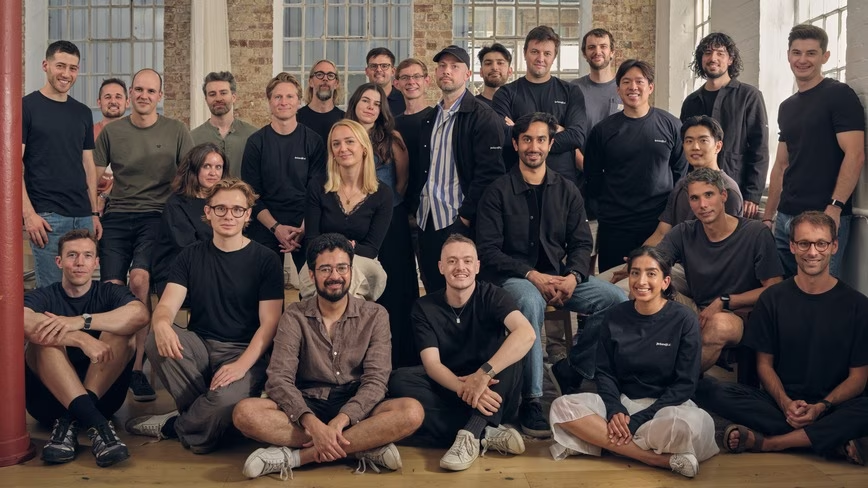 Jack & Jill has raised $40M in a Series A led by Air Street Capital, bringing total funding to $60M less than a year after a $20M seed round. Madrona and Antler are new investors, and Creandum, Ada Ventures, Entrepreneurs First, Expedite Capital, and Repeat.vc all returned. The product is two agents that negotiate with […] This story continues at The Next Web |
15/09/2026 08:10 AM | 3 | |
| 56,744 | 15/09/2026 07:15 AM | Depotcharge lands €2.7M and BGL partnership to scale electric truck charging | depotcharge-lands-euro27m-and-bgl-partnership-to-scale-electric-truck-charging | 15/09/2026 | Munich-based Depotcharge has raised €2.7 million in a pre-seed funding round to expand its shared charging infrastructure platform for electric road freight and support its international growth. The round was led by High-Tech Gründerfonds (HTGF), with participation from xdeck Ventures, Kopa Ventures, Prequel Ventures and business angels from the logistics, e-mobility and energy sectors. As part of its expansion, Depotcharge has also partnered with the Bundesverband Güterkraftverkehr Logistik und Entsorgung (BGL e.V.) to launch BGL Charge, a shared charging network for Germany's road freight sector. Depotcharge is developing a platform that enables logistics companies to make unused charging capacity at their depots available to other fleets. As more operators invest in charging infrastructure for electric trucks, charging points can remain unused for parts of the day, while drivers on the road may have to rely on more expensive public charging infrastructure. The company's platform connects this existing depot capacity into shared charging networks. Depot operators can determine their own prices, access rules and availability, while Depotcharge manages access control, invoicing and payment processing. The platform operates independently of charging hardware, backend systems and vehicle manufacturers. Through BGL Charge, logistics companies can open unused charging points at their depots to other fleets while gaining access to infrastructure provided by other participating operators. BGL Charge also handles marketing, access control, invoicing and payments, while individual depot operators retain control over pricing, availability and access conditions. E.L.V.I.S. AG is also participating in the initiative, pooling demand from its partner companies and representing their interests within BGL Charge. The purchasing cooperative will connect its community to the wider network, giving participating companies access to additional charging locations while generating additional demand at their own depots.
said Joscha Specks, CEO and co-founder of Depotcharge. The new funding will be used to further develop the platform and support Depotcharge's international expansion. The company plans to integrate charging more closely into transport dispatch operations through reservations, open interfaces and connections with existing transport management systems. |
15/09/2026 08:10 AM | 1 |