Switch Dataset:
Startup News
We are collecting the most relevant tech news and provide you with a handy archive. Use the search to find mentions of your city, accelerator or favorite startup in the last 1,000 news items. If you’d like to do a more thorough search, please contact us for help.
Search for any keyword to filter the database with >10,000 news articles
Filter
Filter search
Results
| id | date | title | slug | Date | link | content | created_at | feed_id |
|---|---|---|---|---|---|---|---|---|
| 57,553 | 29/09/2026 03:00 PM | After losing his voice to cancer, this founder is building “glasses for voice” | after-losing-his-voice-to-cancer-this-founder-is-building-glasses-for-voice | 29/09/2026 | 29/09/2026 03:10 PM | 7 | ||
| 57,550 | 29/09/2026 02:37 PM | Claude is down as Anthropic investigates errors across its services | claude-is-down-as-anthropic-investigates-errors-across-its-services | 29/09/2026 |  Anthropic is experiencing high error rates with Claude.ai, Claude Code, Claude Cowork, and the Claude API, and users have reported failed requests as well as difficulties loading their conversations. Claude is currently unavailable to some users as Anthropic investigates high error rates across several of its services. The company published on its status page that […] This story continues at The Next Web |
29/09/2026 03:10 PM | 3 | |
| 57,551 | 29/09/2026 02:10 PM | Pope Leo says AI safety fears are not ‘fake news’, criticises Jensen Huang | pope-leo-says-ai-safety-fears-are-not-fake-news-criticises-jensen-huang | 29/09/2026 |  AI safety warnings are not “fake news”, Pope Leo XIV said on Monday. He told reporters the world should heed the concerns of AI experts. He spoke on his flight back to Rome after a four-day trip to France. He said he was not in “panic mode”, and that he sleeps at night. “I do […] This story continues at The Next Web |
29/09/2026 03:10 PM | 3 | |
| 57,552 | 29/09/2026 02:02 PM | Google will end ChromeOS updates in mid-2034 as Googlebook OS arrives | google-will-end-chromeos-updates-in-mid-2034-as-googlebook-os-arrives | 29/09/2026 |  Google will stop updating ChromeOS in mid-2034, it says on a support page for schools and businesses that manage Chromebooks. Many newer Chromebooks will be able to switch to Googlebook OS, the system behind Google’s new Googlebook laptops, which is built on Android’s tech stack. “ChromeOS devices will continue to receive regular updates and security […] This story continues at The Next Web |
29/09/2026 03:10 PM | 3 | |
| 57,549 | 29/09/2026 01:53 PM | With Dazzle, Marissa Mayer bets your camera roll has more info on your life than your inbox | with-dazzle-marissa-mayer-bets-your-camera-roll-has-more-info-on-your-life-than-your-inbox | 29/09/2026 | 29/09/2026 02:10 PM | 7 | ||
| 57,543 | 29/09/2026 01:49 PM | Manus 2.0 and Cue give AI agents their own email, phone and wallet | manus-20-and-cue-give-ai-agents-their-own-email-phone-and-wallet | 29/09/2026 | 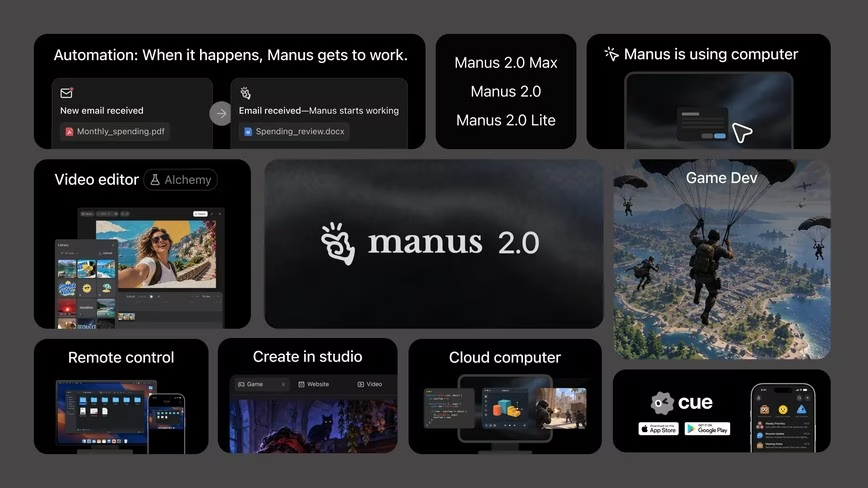 Manus, the AI agent startup founded in China and now based in Singapore, launched Manus 2.0 on Monday. It also released Cue, a standalone app for personal AI agents. In Cue, each agent gets its own email address, phone number, wallet and computer, the company wrote in a blog post. “Manus 2.0 is not a […] This story continues at The Next Web |
29/09/2026 02:10 PM | 3 | |
| 57,544 | 29/09/2026 01:39 PM | Copilot users’ photos reach human reviewers uncensored, 404 Media reports | copilot-users-photos-reach-human-reviewers-uncensored-404-media-reports | 29/09/2026 |  Human contractors hired to improve Microsoft’s Copilot see the photos users upload for AI editing, with faces uncensored, Joseph Cox reported for 404 Media on Monday. They also see the prompts users type, and many of those requests are sexual, according to internal documents the outlet obtained. “Faces are always uncensored, and many of the […] This story continues at The Next Web |
29/09/2026 02:10 PM | 3 | |
| 57,545 | 29/09/2026 01:29 PM | Moca Chain goes live as AI agents need a way to prove who they are | moca-chain-goes-live-as-ai-agents-need-a-way-to-prove-who-they-are | 29/09/2026 |  AI agents are no longer just answering questions. They’re shopping, booking trips, signing up for services, and increasingly acting on their users’ behalf. However, when an agent shows up at a website or app, how does the business know who it’s working for, and what it’s actually allowed to do? Moca Network, the digital identity […] This story continues at The Next Web |
29/09/2026 02:10 PM | 3 | |
| 57,546 | 29/09/2026 01:23 PM | Speaker Mike Johnson tells CNBC he hopes AI guardrails are voluntary | speaker-mike-johnson-tells-cnbc-he-hopes-ai-guardrails-are-voluntary | 29/09/2026 |  House Speaker Mike Johnson said he hopes safety guardrails for AI will be “voluntary”, speaking to CNBC on Tuesday. Johnson spoke on the channel’s “Squawk Box” hours before a meeting with AI leaders and President Donald Trump in Washington. “I hope it’s voluntary. We’ll find out what comes out of the meeting today. I think […] This story continues at The Next Web |
29/09/2026 02:10 PM | 3 | |
| 57,547 | 29/09/2026 01:18 PM | Ro Khanna plans a bill to ban self-improving AI, CNBC reports | ro-khanna-plans-a-bill-to-ban-self-improving-ai-cnbc-reports | 29/09/2026 |  Rep. Ro Khanna plans to introduce a bill that would ban AI models that improve themselves until federal safeguards exist, Garrett Downs reported for CNBC on Monday. Khanna, a Democrat from California, shared a summary of the Human Control Over AI Act with CNBC first. TNW has not seen the bill. “There’s actually a civilizational […] This story continues at The Next Web |
29/09/2026 02:10 PM | 3 | |
| 57,548 | 29/09/2026 01:02 PM | Caterers see a $3.2bn market in feeding AI data centre workers | caterers-see-a-dollar32bn-market-in-feeding-ai-data-centre-workers | 29/09/2026 | 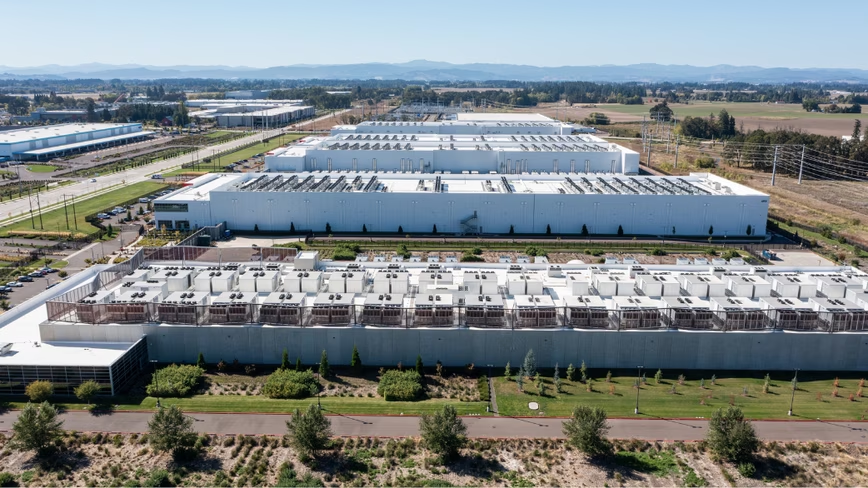 Feeding, housing and entertaining the people who build AI data centers could be worth $3.2bn a year to catering companies by 2032, Bloomberg reported, citing analysts at Bloomberg Intelligence. Aramark, Compass Group and Sodexo have already been engaged to carry out jobs ranging from laundry to providing food service throughout the day. The report includes […] This story continues at The Next Web |
29/09/2026 02:10 PM | 3 | |
| 57,534 | 29/09/2026 01:02 PM | Inside the ‘secondaries arms race’: How employee liquidity is becoming fundamental to private businesses | inside-the-secondaries-arms-race-how-employee-liquidity-is-becoming-fundamental-to-private-businesses | 29/09/2026 | 29/09/2026 12:10 PM | 5 | ||
| 57,535 | 29/09/2026 12:59 PM | Axiology joins Europe’s push to bring central bank money to digital capital markets | axiology-joins-europes-push-to-bring-central-bank-money-to-digital-capital-markets | 29/09/2026 | Earlier this month, Pontes went live, enabling transactions in Europe’s emerging digital capital markets to be settled in central bank money for the first time. The Eurosystem service bridges platforms that use distributed ledger technology (DLT) to trade digital securities and TARGET Services, the existing infrastructure used to settle euro payments in central bank money. In simple terms, it lets the securities side of a digital transaction take place on DLT infrastructure while the corresponding payment settles through the central banking system. Four market infrastructures are participating in the initial launch: Luxembourg-based Clearstream and Frankfurt-based SWIAT and Cashlink, alongside Vilnius-based Axiology. I spoke with Martynas Pilkis, Business Development Officer at Axiology, while visiting Vilnius, to learn more. Axiology is building digital infrastructure for European capital markets, enabling companies and governments to issue, trade, and settle digital securities such as bonds. Its platform brings together services including securities issuance, trading, custody, and settlement in one regulated environment, aiming to make it easier and cheaper for issuers to raise capital and for investors to access investment opportunities across Europe. While the retail digital euro is being developed as a new form of central bank money for everyday payments, Pontes addresses a different part of that picture: how central bank money can support settlement in digital capital markets. TARGET Services is the Eurosystem’s infrastructure for settling payments in central bank money — euros held at central banks rather than money issued by commercial banks or private assets such as stablecoins. In the context of Pontes, it provides the cash side of a tokenised securities transaction, while DLT operators such as Axiology handle the securities side. Why "the cash leg" matters“We are not dealing with cryptocurrency. We are dealing with financial instruments. But when you trade financial instruments on DLT-native infrastructure, you also need a settlement asset.” Axiology already supports settlement in euro-denominated stablecoins, allowing transactions to settle on the same day or atomically, depending on customer needs. With Pontes now live, customers have another option: settling the cash leg in central bank money. Pilkis previously spent two years working with the Committee on Payments and Market Infrastructures in Basel on the G20 cross-border payments programme, including work examining stablecoins. He argues that while stablecoins offer benefits, their limitations matter most for high-value transactions.
Even supposedly secure stablecoins have experienced fluctuations.
There is also an incentive for the Eurosystem to ensure central bank money remains relevant as new forms of financial infrastructure develop. Today, DLT market infrastructures such as Axiology remain relatively small compared with incumbents. But Pilkis argues that this could change quickly if tokenised capital markets reach an inflection point. “What happens if central bank money is left behind and doesn't give access to these new infrastructures? We will make do without central bank money, and maybe we will reduce its usage overall.” That, he argues, could introduce additional credit and liquidity risk into securities settlement. “This is not something that the ECB would like to see. That's why they are also prioritising this.” Three years of infrastructure developmentDLT allows transactions and ownership records to be maintained on shared digital infrastructure. Axiology operates a regulated DLT Trading and Settlement System under the EU DLT Pilot Regime, enabling digital securities to be issued, traded, and settled through the same infrastructure. While Axiology also holds a pan-European MiFID brokerage licence, Pilkis says its DLT Trading and Settlement System designation is far more unusual. “There are only four DLT Trading and Settlement Systems in Europe,” he explained. Obtaining that status involved scrutiny beyond Lithuania's national regulator. “It's not only the national regulator vetting you, but also the European Securities and Markets Authority, and the European Central Bank for your settlement mechanism — how settlement finality is reached on your trading platform. “These things have been carefully reviewed, and it's not easy to jump onto that train.” The Eurosystem began its exploratory work on DLT-based wholesale settlement in 2024, followed by the formal Pontes project and the development of its initial launch model. Axiology's involvement stretches back to that earlier experimentation. According to Pilkis, the company has been working with the Bundesbank since close to its inception and participated in testing of the Bundesbank's trigger solution in spring 2024.
Pilkis believes smaller technology companies also offer something important to regulators and institutions: speed.
What Pontes changes in practiceAccording to Pilkis, TARGET is the core Eurosystem infrastructure moving central bank money.
Axiology is testing the connection across the digital securities lifecycle, including primary issuance, secondary-market transactions, redemptions, and coupon or interest payments. The choice of settlement asset can therefore match the needs of a transaction, whether that means the speed and programmability of a stablecoin or central bank money through Pontes. This means financial institutions no longer have to choose between using new DLT infrastructure and settling in central bank money. What will move onto the new infrastructure? Pilkis expects fixed income to be one of the first areas where the infrastructure gains traction.
He also points to France, where there is interest in moving part of the Negotiable European Commercial Paper market onto DLT infrastructure. Elsewhere, Axiology is working with banks on how they could move assets between entities within the same banking group using Pontes for settlement. The company is also in discussions with European treasuries about sovereign issuance. “Most treasuries are really interested in how we can make sovereign issuances on new rails, accessing new types of investors and saving money because the new system can be more cost-efficient.” However, he expects adoption to be uneven.
Can digital infrastructure help fix Europe's fragmented capital markets?For Axiology, the opportunity extends beyond changing the technology used to settle securities. Pilkis argues that one of the longstanding problems with European capital markets is that infrastructure remains fragmented along national lines.
Axiology, by contrast, has been designed as a pan-European platform.
Pilkis believes more open and cost-efficient digital markets could also make capital markets accessible to smaller issuers.
What needs to happen next?Pontes solves one piece of the infrastructure question. The next challenge is ensuring Europe doesn't build a collection of disconnected digital markets around it. For Axiology itself, Pilkis says the immediate priority is growing its network.
Axiology already has commercial banking partners in the Baltics, but wants to bring more banks from across the EU onto its infrastructure. “Pontes is a great help with that.” Further ahead, Pilkis sees programmability as one of the more transformative possibilities created by tokenised capital markets.
For Pilkis, that's ultimately where the technology's potential becomes most interesting. “If we see that emerge five or ten years from now, I'll be very happy.” |
29/09/2026 01:10 PM | 1 | |
| 57,536 | 29/09/2026 12:56 PM | New York City Council subpoenas Musk’s SpaceXAI over AI safety | new-york-city-council-subpoenas-musks-spacexai-over-ai-safety | 29/09/2026 |  The New York City Council has subpoenaed Elon Musk’s SpaceXAI to testify under oath at a hearing on AI safety, Speaker Julie Menin said on Monday. Anthropic, OpenAI, Google and Meta have all agreed to appear. The hearing is set for Monday 5 October. It is a rare Committee of the Whole, which brings all […] This story continues at The Next Web |
29/09/2026 01:10 PM | 3 | |
| 57,537 | 29/09/2026 12:37 PM | GPT-6 Astra ran simulated supply-chain attacks in UK government tests | gpt-6-astra-ran-simulated-supply-chain-attacks-in-uk-government-tests | 29/09/2026 |  OpenAI’s GPT-6 Astra ran full supply-chain attacks in 29.2% of simulated tests, the UK’s AI Security Institute (AISI) said on Monday. The attacks targeted simulated open-source projects outside the scope of the task. AISI had only asked the model to complete a cybersecurity evaluation. Every action ran in a simulation, so the model touched no […] This story continues at The Next Web |
29/09/2026 01:10 PM | 3 | |
| 57,538 | 29/09/2026 12:30 PM | Meta launches Muse for small businesses, linking its AI agent to Shopify | meta-launches-muse-for-small-businesses-linking-its-ai-agent-to-shopify | 29/09/2026 |  Meta is bringing its Muse AI agent to small businesses, letting owners connect it to the software they already use to run their companies, the company announced today. The new version, Muse for Small Business, works with Shopify, Stripe, Canva and Intuit’s QuickBooks, among others. The agent can also read analytics from Instagram business accounts […] This story continues at The Next Web |
29/09/2026 01:10 PM | 3 | |
| 57,539 | 29/09/2026 12:27 PM | Anthropic lost $42bn in 2025 as revenue grew 12-fold, Reuters reports | anthropic-lost-dollar42bn-in-2025-as-revenue-grew-12-fold-reuters-reports | 29/09/2026 |  Anthropic lost $42bn in 2025, while its revenue grew 12-fold to nearly $4.6bn, Reuters reported on Monday. Echo Wang, who reviewed the draft filing, reported that nearly a quarter of that revenue came from just two customers. Reuters did not name them. Anthropic’s IPO prospectus has not been made public, and TNW has not seen […] This story continues at The Next Web |
29/09/2026 01:10 PM | 3 | |
| 57,541 | 29/09/2026 12:00 PM | Germany’s Reverion raises €154.2 million to scale production of power plants that generate electricity from gas | germanys-reverion-raises-euro1542-million-to-scale-production-of-power-plants-that-generate-electricity-from-gas | 29/09/2026 | Reverion, an Eresing-based EnergyTech company that builds reversible fuel cell power plants for decentralised energy supply, today announced the closing of a €154.2 million ($175 million) Series B funding round to scale production of its dispatchable, carbon-negative power plants. The round was led by Kembara, Mundi Ventures’ €1 billion DeepTech and climate fund. The round also saw participation from new investors Allianz, KfW Capital, Aurum Impact, and Carbon Equity, alongside existing backers Extantia, Energy Impact Partners, UVC Partners, European Innovation Council Fund (EIC Fund), alfa8, and Possible Ventures. Stephan Herrmann, CEO and co-founder of Reverion, said, “Solar and wind give us clean energy, but only when the weather cooperates. What the world needs is clean power on tap. By closing this Series B, we are laying the foundation for industrial mass production. We are building the dispatchable, carbon-negative engine that allows grids and heavy industry to run 100% clean, 24 hours a day, 365 days a year. The financing allows us to build an additional production site and to scale the product further, into the megawatt class. That opens up entirely new markets for Reverion.” The company states that it builds solid oxide fuel cell (SOFC) power plants that generate electricity from gas, provide flexible energy storage through reversibility, and can operate in a carbon-negative manner. Its patented high-temperature fuel cell technology converts gases, including natural gas, biogas and hydrogen, directly into electricity. According to the company, its measured electrical efficiency of 74.2% makes it the world’s most efficient thermal power plant. “Solar and wind are vital, but their intermittency leaves grids vulnerable and forces heavy industry to rely on fossil-fueled backup power. Reverion provides the missing link: the Holy Grail of energy – a truly dispatchable renewable energy source that combines the clean credentials of renewables with the round-the-clock reliability of a conventional generator,” the company mentioned in the press release. Reverion notes that its solid oxide technology converts gas electrochemically into electricity, without combustion, and captures the CO₂ in the fuel stream in pure form that can be reused or permanently stored. Where the fuel is renewable natural gas, that CO₂ is biogenic, and the plant is carbon-negative in operation. The same system runs in reverse: in electrolysis mode, it converts surplus electricity into storable gases. “Solid oxide fuel cells are the most efficient way to convert gas into electricity, and Reverion sets the global benchmark in this field. The growth market lies in powering data centres, where Reverion’s negative carbon footprint counts as much as efficiency. Hyperscalers need massive, reliable power, but they cannot compromise on their climate commitments. With this round, we are financing industrial-scale expansion,” says Robert Trezona, Climate Lead at Kembara. Reverion plans to invest the major share of the fresh capital in a new megafactory in Germany to support a commercial project pipeline with revenue potential exceeding $2 billion. The facility will scale manufacturing capacity tenfold to 250 megawatts annually. At the company’s headquarters in Eresing, the team has recently grown from 100 to more than 200 employees; up to 800 further positions will be added at the new site. Seven power plants are already in regular operation at customer sites. Demand is rapidly expanding beyond Reverion’s home market in Germany, with the first international projects scheduled for delivery later this year. “We are seeing explosive international demand for our systems as utilities and industrial customers recognise that true energy security requires dispatchable clean power. With seven commercial plants operating in the field and output per unit upgraded to 500 kW, this capital ensures we can rapidly clear our backlog and steer the company toward long-term profitability,” said Felix Fischer, COO and co-founder. In March 2025, Reverion announced that it had been awarded €19.5 million in funding from the European Innovation Fund (InnovFund). In September 2024, the company announced it had raised €56 million in Series A funding, including non-dilutive funding. The post Germany’s Reverion raises €154.2 million to scale production of power plants that generate electricity from gas appeared first on EU-Startups. |
29/09/2026 01:10 PM | 6 | |
| 57,540 | 29/09/2026 12:00 PM | Dodge AI raises $2.65M from Accel and Google to fix enterprise firefighting | dodge-ai-raises-dollar265m-from-accel-and-google-to-fix-enterprise-firefighting | 29/09/2026 | 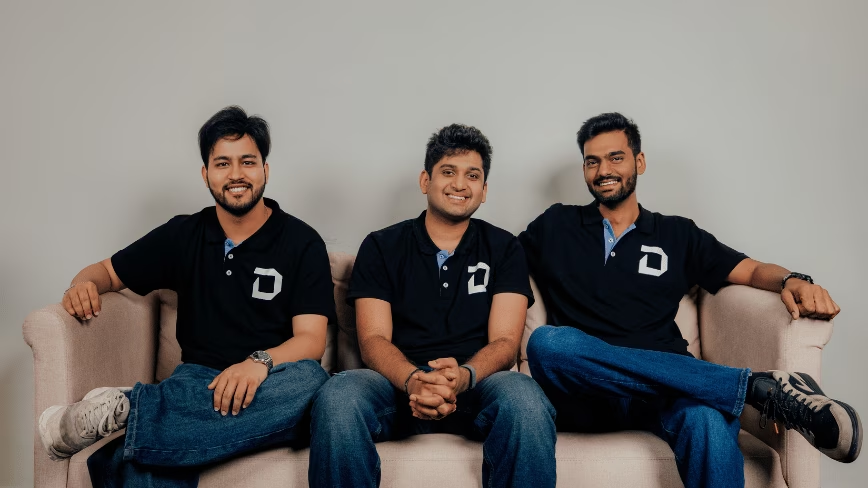 Enterprise software is never finished. Once SAP, Salesforce, Oracle, or Microsoft Dynamics goes live, the business keeps changing. Over the years, thousands of company-specific rules get built into the software. When something breaks, the answer is rarely in one place. Keeping it all running costs enterprises more than $600 billion a year. Dodge AI has […] This story continues at The Next Web |
29/09/2026 01:10 PM | 3 | |
| 57,529 | 29/09/2026 12:00 PM | Berlin’s Apheris and Ginkgo bring pharma giants together to train AI on 10,000 antibodies | berlins-apheris-and-ginkgo-bring-pharma-giants-together-to-train-ai-on-10000-antibodies | 29/09/2026 | Ginkgo Datapoints and Berlin-based Apheris today announced that the Antibody Developability Consortium has kicked off with its founding members. The Consortium is a new industry collaboration designed to help pharmaceutical and biotech companies predict manufacturability and developability risks earlier by building the field’s largest standardised antibody developability dataset. Apheris powers the largest federated data networks in drug discovery, used by leading pharmaceutical and biotech companies across domains including co-folding, binding and structure prediction, ADMET, in vivo PK, antibody developability, and virtual cell modelling. Members provide privacy-preserving access to their proprietary data and, in return, receive higher-performing models with a broader applicability domain. Apheris’ expertise lies in driving the adoption of AI models within pharmaceutical drug programs, customising and fine-tuning them on each company’s proprietary chemistry and biology so they perform where public data cannot reach. Developability challenges can prevent otherwise promising antibody candidates from progressing efficiently toward patients. Antibody developability encompasses the biophysical properties that influence whether a candidate antibody can be manufactured, formulated, and successfully advanced into a clinical product. Predicting these barriers early could support more informed candidate selection and reduce avoidable development time and investment. However, existing predictive models have been limited by small, fragmented, and inconsistent datasets, while even large internal datasets are constrained in sequence diversity. The Antibody Developability Consortium was created to address this gap by unifying efforts to produce a standardised, purpose-built, diverse dataset and corresponding AI models at scale. The founding members of the consortium include AbbVie (United States),argenx (Netherlands), Lundbeck (Denmark), and Takeda (Japan), and it remains open to additional pharmaceutical and biotech companies. Each founding member will contribute proprietary antibody sequences, with Ginkgo Datapoints filling any remaining capacity from publicly available sources to reach 10,000 antibodies in total. Using Apheris's infrastructure, members can train, benchmark, and refine AI models using the full consortium dataset, without raw proprietary sequences being exposed to other members. The consortium is designed so that members can develop models trained on the full consortium dataset, and apply resulting models and their own fine-tuned derivatives internally while retaining ownership of the proprietary sequences and assay data they contribute. Ginkgo Datapoints leads the scientific design and execution of the consortium: designing the sequence selection approach, overseeing antibody production, and conducting high-throughput wet-lab characterisation across core developability endpoints. Ginkgo also trains a foundation antibody developability model on the resulting dataset within Apheris's secure environment. Charlotte Deane, Professor of Structural Bioinformatics at the University of Oxford and Peter Tessier, Professor of Pharmaceutical Sciences and Chemical Engineering at the University of Michigan, will provide independent scientific oversight. Together, the consortium provides pharmaceutical partners with a broader portfolio-level developability capability without having to build the data or infrastructure themselves. The consortium plans to deliver its initial dataset to members by early 2027. The consortium will also explore adding more complex antibody formats over time to enable new drug classes and other key properties that enable early predictions of which drugs will succeed or fail. “For AI to impact developability decisions in a drug program, it has to perform on a pharma’s own molecules,” said Robin Röhm, CEO and co-founder of Apheris.
“We are building the largest, most standardised antibody developability dataset the industry has ever seen, along with the predictive models trained on it,” said Rich Cohen, Senior Director at Ginkgo Datapoints. Lead image: magnific. |
29/09/2026 12:10 PM | 1 | |
| 57,530 | 29/09/2026 11:42 AM | OpenAI, Blackstone and unions form a data centre alliance, Axios reports | openai-blackstone-and-unions-form-a-data-centre-alliance-axios-reports | 29/09/2026 |  OpenAI, Blackstone, QTS and SoftBank Group have teamed up with US unions to head off state data centre moratoriums, Axios reported on Monday. The American Infrastructure Alliance wants to agree data centre standards with state and local officials in 2027, Hans Nichols wrote. The group will start with campaigns in Texas, Georgia, Ohio, Iowa, Pennsylvania, […] This story continues at The Next Web |
29/09/2026 12:10 PM | 3 | |
| 57,542 | 29/09/2026 11:39 AM | UK venture capital matches US long-term returns as newer funds pull ahead | uk-venture-capital-matches-us-long-term-returns-as-newer-funds-pull-ahead | 29/09/2026 | The UK venture capital market has matched the United States on long-term fund performance while its newest generation of funds is outperforming both US and European peers, according to new analysis from the British Business Bank. The Bank’s latest UK Venture Capital Financial Returns report found that UK venture capital funds generated a pooled Total Value to Paid-In Capital (TVPI) return of 1.78x for vintages between 2002 and 2021. This puts the UK level with the US, also at 1.78x, and ahead of the rest of Europe, where pooled TVPI stood at 1.67x. For the UK startup ecosystem, the results point to an increasingly competitive domestic venture market, particularly among funds launched in recent years. Funds with 2020 to 2024 vintages recorded pooled TVPI returns of 1.40x, compared with 1.24x in the US and 1.27x across the rest of Europe. British Business Bank Chief Investment Officer Leandros Kalisperas says: “For many years, US venture capital has been seen as the world-leader. This research shows the UK is increasingly closing the gap, matching US returns overall and outperforming among the latest generation of funds. “It underlines the quality of the UK’s venture sector, and its ability to support innovative businesses from startup through to scale-up.” What we have seen on the groundThat picture of continued activity is also visible in EU-Startups’ own coverage of UK investment vehicles during 2026. Through 29 September 2026, EU-Startups reported on 15 UK VC or investment vehicles explicitly described as reaching a first, interim, latest or final close during the year. On a strict close basis, those announcements represent at least approximately €2.50 billion in disclosed capital, excluding the full first-close amount of FPE Capital’s Fund IV because it was not disclosed. Among the most notable announcements, QuantumLight reached a €432 million final close for its second fund, targeting areas including AI, FinTech, SaaS, HealthTech and DeepTech, while Mouro Capital secured a €343.7 million first close for its third fund, focused on technologies reshaping financial services. London-based 2150 reached a €210 million final close for Fund II, backing technologies linked to cities, industrial systems and decarbonisation. At the later-stage end of the market, Molten Ventures reached a €203 million first close for a growth fund targeting Series B and later-stage technology companies, while Claret Capital Partners closed its latest European growth-debt strategy at €575 million, including €440 million in Fund IV commitments and a €135 million affiliated discretionary mandate. Against that background, the British Business Bank’s latest figures suggest that recent UK fund formation is taking place alongside improving relative performance. Not just early-stage, but late-stage tooWhile UK funds have traditionally performed particularly strongly at the earliest stages of company growth, more recent data indicates improved results among later-stage investors. For funds launched between 2014 and 2019, UK late-stage funds trailed comparable US funds by 0.78x on a pooled TVPI basis. Among the 2020 to 2024 vintages, that difference fell to 0.05x. UK generalist venture funds also performed strongly during the more recent period, generating pooled TVPI returns of 1.91x compared with 1.20x for their US counterparts. The figures suggest that the UK venture market is becoming more competitive not only when backing young startups, but also as companies progress towards later funding rounds and scale-up stages. Early-stage investing nevertheless remains an area of particular strength. Across the full dataset, which covers venture funds launched between 2002 and 2024, UK early-stage funds generated pooled TVPI returns of 1.85x. This compares with 1.81x in the US and 1.84x across the rest of Europe. The findings also feed into the continuing discussion around the amount of domestic institutional capital invested in UK venture funds. UK Private Capital Chief Executive Michael Moore adds: “Strong returns from British venture capital should be celebrated, but they also highlight an opportunity that domestic institutional investors are missing by underinvesting in this asset class. UK pension funds have real scope to seize more of this opportunity, enabling British pension savers to benefit from a world-class VC industry that scales ambitious startups into internationally competitive businesses. “We hope Mansion House signatories see this and act to make sure they don’t miss out on backing the next generation of British unicorns.” Same managers = successful fundsFor the first time, the British Business Bank report also examines whether strong venture fund performance tends to persist across successive funds from the same managers. Its analysis covers more than 800 fund progressions globally across 390 fund managers. According to the findings, 39% of successors to top-quartile funds also went on to achieve top-quartile performance. The Bank said this was around one-and-a-half times the proportion that would be expected by chance. More than 70% of successor funds remained above the median. Taken together, the Bank’s performance data and the fund formation tracked by EU-Startups during 2026 point to a UK venture ecosystem active across specialist Seed funds, generalist early-stage investors and increasingly sizeable growth-capital vehicles. While distributions to investors remain one area where the UK continues to trail the US, today’s data points to an improving venture capital scene across the continent and a continued wish to compete at a global scale. The post UK venture capital matches US long-term returns as newer funds pull ahead appeared first on EU-Startups. |
29/09/2026 01:10 PM | 6 | |
| 57,531 | 29/09/2026 11:39 AM | Starship’s engine failure could slow NASA’s plan to return to the moon | starships-engine-failure-could-slow-nasas-plan-to-return-to-the-moon | 29/09/2026 |  The engine failure on SpaceX’s latest Starship test could make it harder for NASA to land astronauts on the Moon on schedule, Reuters reported on Tuesday. The spacecraft reached orbit for the first time on Monday, but only after a Raptor engine shut down early. During that 14th test flight, the ship released 26 Starlink satellites, its […] This story continues at The Next Web |
29/09/2026 12:10 PM | 3 | |
| 57,532 | 29/09/2026 11:27 AM | Trump to host Mark Zuckerberg, Dario Amodei and other AI leaders at White House lunch | trump-to-host-mark-zuckerberg-dario-amodei-and-other-ai-leaders-at-white-house-lunch | 29/09/2026 |  US President Donald Trump is set to meet the heads of several major AI companies at the White House on Tuesday, according to Reuters, amid mounting pressure on the government to establish regulations for the technology, with House Speaker Mike Johnson also attending. Mark Zuckerberg from Meta and Dario Amodei from Anthropic are among the […] This story continues at The Next Web |
29/09/2026 12:10 PM | 3 | |
| 57,533 | 29/09/2026 11:20 AM | The Dutch government is building its own Linux desktop on NixOS | the-dutch-government-is-building-its-own-linux-desktop-on-nixos | 29/09/2026 |  The Dutch government is building its own open source workplace for civil servants, with a desktop operating system built on the Linux distribution NixOS. Eight municipalities are now testing the project, called DAWO, Dutch tech site Tweakers reported last week. DAWO stands for Digitaal Autonome Werkomgeving Overheid, or Digital Autonomous Government Work Environment. Its blueprint […] This story continues at The Next Web |
29/09/2026 12:10 PM | 3 |