Switch Dataset:
Startup News
We are collecting the most relevant tech news and provide you with a handy archive. Use the search to find mentions of your city, accelerator or favorite startup in the last 1,000 news items. If you’d like to do a more thorough search, please contact us for help.
Search for any keyword to filter the database with >10,000 news articles
Filter
Filter search
Results
| id | date | title | slug | Date | link | content | created_at | feed_id |
|---|---|---|---|---|---|---|---|---|
| 57,104 | 21/09/2026 04:00 PM | The state of the American advertiser | the-state-of-the-american-advertiser | 21/09/2026 |  American advertisers are operating in a media environment with more channels, more data, and more technology than ever before. Yet for marketers, the central challenge is shifting. It is less about finding another place to advertise. It is more about understanding how every investment contributes to the broader business. That is the environment Rob DeSalvo […] This story continues at The Next Web |
21/09/2026 04:10 PM | 3 | |
| 57,105 | 21/09/2026 03:59 PM | Amazon blocks Meta’s Muse and accuses Perplexity of misleading a court | amazon-blocks-metas-muse-and-accuses-perplexity-of-misleading-a-court | 21/09/2026 |  Amazon fought AI shopping agents on two fronts on Monday. It blocked Muse, Meta’s new AI assistant, from Amazon.com. It also filed an amended complaint against Perplexity, accusing the company of misleading a federal appeals court. The block came first. People who sent Muse to shop on Amazon over the weekend began seeing a popup. […] This story continues at The Next Web |
21/09/2026 04:10 PM | 3 | |
| 57,106 | 21/09/2026 03:43 PM | Volvo names Klaus Zellmer as chief executive | volvo-names-klaus-zellmer-as-chief-executive | 21/09/2026 |  Volvo Cars has appointed Klaus Zellmer, chairman of the board of management at Skoda Auto, as president and chief executive, taking over from Hakan Samuelsson no later than 1 October 2027. Skoda posted an 8.5% operating margin in the first half of 2026, against Volvo’s 3.5% for last year and an 8% target with no […] This story continues at The Next Web |
21/09/2026 04:10 PM | 3 | |
| 57,107 | 21/09/2026 03:35 PM | Amazon puts another $1.9bn into its delivery partner programme for 2027 | amazon-puts-another-dollar19bn-into-its-delivery-partner-programme-for-2027 | 21/09/2026 |  “Specifics will vary by DSP and geography, as each DSP determines how best to invest in their business and teams,” Amazon wrote on Monday. That sentence sits four lines below the headline figure, which is that drivers will earn a national average of nearly $24 an hour. Amazon said it will put another $1.9bn into […] This story continues at The Next Web |
21/09/2026 04:10 PM | 3 | |
| 57,108 | 21/09/2026 03:20 PM | Dragos closes its NetRise and runZero deals as Accenture takes control | dragos-closes-its-netrise-and-runzero-deals-as-accenture-takes-control | 21/09/2026 | 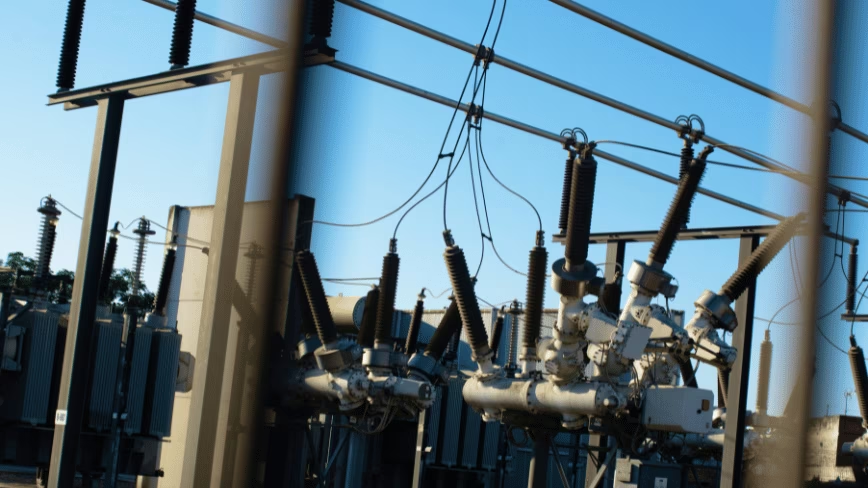 “It’s about whether the lights stay on and the water stays safe when an adversary attacks,” said Dmitri Alperovitch, the CrowdStrike co-founder who is returning to the board of Dragos. The industrial cybersecurity company said on Monday it has closed its acquisitions of NetRise and runZero. The deals completed alongside the close of Accenture’s majority […] This story continues at The Next Web |
21/09/2026 04:10 PM | 3 | |
| 57,103 | 21/09/2026 03:15 PM | FintechOS raises $28M in equity and debt | fintechos-raises-dollar28m-in-equity-and-debt | 21/09/2026 | Romania-founded startup FintechOS, which provides AI and software services for banks and insurance firms, has raised $28m in equity and debt funding from its current investors, it said today. The 2017-founded startup, which is headquartered in London and also has offices in Bucharest and New York, has received equity funding from its existing investors, including Bek Ventures, IFC, Cipio Partners and Molten Ventures, alongside a debt facility from Santander Corporate Investment Banking. FintechOS has raised more than $150m in total. It says it will use the funding to expand in the US, help it win more European clients, and scale up its AI tech. FintechOS is a B2B software firm that helps banks and insurance firms launch and manage financial products without them having to replace their core items, acting as a tech layer on top of banking and insurance systems, providing AI and other tech services. The startup said it had reached profitability in the first half of 2026, driven by US growth, it said. Cyril Desouza, CFO, FintechOS, said: "Reaching profitability was not an accident, it was the outcome of a deliberate, multi-year effort to get our cost base, our margins and our delivery practice right before we pushed harder on growth again. Now that discipline is paying off twice over: the business has reached profitability, and we've already made the shift back into high growth, which is exactly the combination that lets us take on a round like this one." |
21/09/2026 04:10 PM | 1 | |
| 57,109 | 21/09/2026 03:00 PM | Where will the next breakout startup come from? Benchmark’s full partnership weighs in at TechCrunch Disrupt 2026 | where-will-the-next-breakout-startup-come-from-benchmarks-full-partnership-weighs-in-at-techcrunch-disrupt-2026 | 21/09/2026 | 21/09/2026 04:10 PM | 7 | ||
| 57,097 | 21/09/2026 02:58 PM | Amber Electric raises €49m to take home battery automation to Europe | amber-electric-raises-euro49m-to-take-home-battery-automation-to-europe | 21/09/2026 |  “We’ve built a leading energy automation platform in Australia, and this investment gives us the backing to build on that leadership globally,” said Chris Thompson, co-founder of Amber Electric. The Melbourne company has raised €49m in a Series E round, Morgan Stanley Investment Management said on Monday. 1GT led the round. It is the private […] This story continues at The Next Web |
21/09/2026 03:10 PM | 3 | |
| 57,100 | 21/09/2026 02:47 PM | The 21 European investors funding NATO’s defence and innovation | the-21-european-investors-funding-natos-defence-and-innovation | 21/09/2026 | NATO’s Defence Innovation Accelerator for the North Atlantic (DIANA) has announced the first 24 investors who are joining the NATO DIANA Capital Network (NDCN), among which 21 are European-based – including Bpifrance, DTCP, and Project A. The NDCN is a trusted community of NATO-aligned investors who’s aim will be to help scale innovative solutions critical to Allied security. “The NATO DIANA Capital Network is a critical enabler of the Alliance’s technological and defensive edge,” says NATO DIANA Acting Managing Director Jyoti Hirani-Driver. “By connecting NATO-aligned capital and promising innovators, the network helps the best technologies move to real-world capabilities in a secure and values-based ecosystem. We are proud to welcome the network’s first 24 investors and look forward to growing this community across the Alliance.” The launch of the NATO DIANA Capital Network comes amid substantial capital deployment into European defence and dual-use technology in 2026. EU-Startups has seen approximately €1.73 billion across ten relevant company financings this year, led by Munich-based Quantum Systems’ €1 billion Series D, ICEYE’s €450 million Series F in Finland and London-based Kraken Technology Group’s €152.9 million Series B. Smaller rounds have also backed missile manufacturing, autonomous aerial intelligence, drone-defence lasers, unmanned-systems software and strategic advanced materials. Several members of the new network are already active across these financings: DTCP led investments in Kraken and Norway’s Six Robotics, while the NATO Innovation Fund participated in rounds for Kraken, Greenjets and Uplift360 and led Kelluu’s €15 million Series A. Kelluu is also a direct link to DIANA, having completed two phases of the NATO accelerator before its 2026 financing. Alongside company-level investment, EU-Startups has covered dedicated 2026 defence and resilience vehicles including DTCP’s €500 million Project Liberty, the €500 million E2D fund and Lakestar’s €262.2 million Resilience I Fund, pointing to a broader build-out of specialised capital for European defence and dual-use technologies. The NDCN was launched in April 2026 and is a curated, NATO-screened community of trusted investors committed to backing the dual-use and DeepTech companies emerging from the DIANA programme. Members are sovereign and sovereign-backed funds, leading venture capital firms, family offices, and institutional investors drawn from across the 32 NATO Allied nations. The NDCN provides its members with structured access to DIANA’s screened company pipeline, direct connections to fellow Alliance investors, invitations to closed convenings with NATO leadership and end-users, and a zero-fee model from DIANA itself. The NDCN forms part of the wider NATO DIANA network, which finds and accelerates cutting-edge technologies to deliver battle-winning defence and security solutions for the Alliance, while fostering DeepTech innovation. DIANA will welcome more investors in the NDCN towards the end of the year. NDCN members will have opportunities to engage with DIANA-validated innovators; companies whose technologies have already been tested and de‑risked against NATO and Allied capability needs. Divided by European country of origin, the 24 inaugural investors are: Germany
France
United Kingdom
Poland
Netherlands
Norway
Luxembourg
Türkiye
International
The post The 21 European investors funding NATO’s defence and innovation appeared first on EU-Startups. |
21/09/2026 03:10 PM | 6 | |
| 57,098 | 21/09/2026 02:47 PM | Bending Spoons opens a Warsaw office after 50,000 Polish applications | bending-spoons-opens-a-warsaw-office-after-50000-polish-applications | 21/09/2026 |  “We’ve received around 50,000 applications from Poland so far this year, more than twice as many as the whole of 2025,” said Andrea Maiorana, Bending Spoons’ talent data lead. The Milan company said on Monday that it has opened an office in Warsaw. It is the company’s fourth office in Europe. The others are its […] This story continues at The Next Web |
21/09/2026 03:10 PM | 3 | |
| 57,101 | 21/09/2026 02:30 PM | From first users to billions: Google’s Robby Stein joins TechCrunch Disrupt 2026 | from-first-users-to-billions-googles-robby-stein-joins-techcrunch-disrupt-2026 | 21/09/2026 | 21/09/2026 03:10 PM | 7 | ||
| 57,099 | 21/09/2026 02:24 PM | A Microsoft scientist called AI training the largest theft of labor | a-microsoft-scientist-called-ai-training-the-largest-theft-of-labor | 21/09/2026 |  A 92-page brief unsealed on Thursday opens by quoting the same Microsoft employee twice. Dr Brent Hecht, the company’s Director of Applied Science, wrote that people would come to see large models hoovering up their work as “an astonishing theft of unprecedented proportions”. In a second document he called it perhaps the “largest theft of […] This story continues at The Next Web |
21/09/2026 03:10 PM | 3 | |
| 57,102 | 21/09/2026 02:15 PM | Meet the next wave of VCs judging Startup Battlefield 200 at TechCrunch Disrupt 2026 | meet-the-next-wave-of-vcs-judging-startup-battlefield-200-at-techcrunch-disrupt-2026 | 21/09/2026 | 21/09/2026 03:10 PM | 7 | ||
| 57,093 | 21/09/2026 01:57 PM | Five makers, one laptop: Googlebook pre-orders open from $899 | five-makers-one-laptop-googlebook-pre-orders-open-from-dollar899 | 21/09/2026 |  Pre-orders for the Googlebook opened on Monday, starting at $899, with the first ones reaching shops in the United States on 4 October. In Canada, the UK, Ireland, France, Germany and Australia will arrive on 5 October. Google has not said what they will cost in any of those markets, and the only price published is in […] This story continues at The Next Web |
21/09/2026 02:10 PM | 3 | |
| 57,096 | 21/09/2026 01:49 PM | Corridor raises $25M seed to build a health benefits brokerage for SMBs | corridor-raises-dollar25m-seed-to-build-a-health-benefits-brokerage-for-smbs | 21/09/2026 | 21/09/2026 02:10 PM | 7 | ||
| 57,094 | 21/09/2026 01:30 PM | The EU will rate data centres on energy and water from 2027 | the-eu-will-rate-data-centres-on-energy-and-water-from-2027 | 21/09/2026 |  Europe’s data centers are to be graded on how much energy and water they use, under a rating scheme proposed on Monday by the European Commission. Any individual site drawing more than 500 kW is covered. What the rating measures is not only consumption but what a data center puts back: heat recovered and reused, clean […] This story continues at The Next Web |
21/09/2026 02:10 PM | 3 | |
| 57,095 | 21/09/2026 01:25 PM | The startups fixing Europe’s AI power problem | the-startups-fixing-europes-ai-power-problem | 21/09/2026 | Earlier this year, I wrote about the AI power crisis and argued that coordination now matters more than new capacity. The numbers have not improved. Research from the International Energy Agency (IEA) shows that global data centre electricity demand is projected both to roughly double, from 485 TWh in 2025 to around 950 TWh by 2030, and to grow more than four times faster than total electricity demand from all other sectors. Much of the capacity Europe needs already exists but sits unused most of the time. Software that orchestrates existing assets unlocks that headroom years before new lines and substations can. Following the first piece, my colleague Anna Trendewicz and I looked into who is actually building this software in Europe. We found a small group of companies working across the four efficiency layers: grid, facility, compute and software. Grid: making existing capacity visibleAmsterdam’s Sympower and Dublin-based GridBeyond have each raised more than €70 million. Both turn data centres and industrial energy users into flexible grid assets by aggregating their demand and bidding it into balancing markets across multiple European countries. Munich’s Entrix ranks among Germany’s more established battery storage optimisers and trades flexible capacity across day-ahead, intraday and balancing markets. Finland’s Capalo AI runs a virtual power plant that had contracted more than 1 GW of battery storage by the end of 2025 and has since then expanded from the Nordics and Baltics into Poland and Bulgaria. London’s Piclo operates a flexibility marketplace that connects distributed energy assets with grid operators, and Vienna’s enspired automates AI-driven trading of flexible assets across European power spot markets (Note: Future Energy Ventures is an investor in both Piclo and enspired). None of these companies started out as a data centre specialist. Most built their platforms for industrial and renewable flexibility, which shows how new the AI-specific version of this problem still is. Facility: the physics layerDarmstadt-based etalytics, a spin-off from TU Darmstadt, optimises the cooling, heating and power systems inside a facility. Its etaONE platform combines AI with physics-based digital twins and model predictive control, and operators can either let it adjust set points automatically or approve its recommendation manually. Data centre customers include Equinix, Digital Realty, NTT and Telehouse. NTT Global Data Centers cut cooling energy by 19% with the software, and Telehouse Germany cut cooling electricity by 10.4% at its Frankfurt campus, a site it already considered well optimised. Across its customer base, etalytics reports savings up to 50%. In 2025, M12, Microsoft’s venture fund, led an €8 million extension that brought its Series A to €16 million, and etalytics opened its U.S. business this year. For AI operators this matters beyond the energy bill. A site with a fixed grid connection can shift every kilowatt it saves on cooling to its IT load, which turns efficiency directly into sellable rack capacity without a new site or new interconnection. Rotterdam’s Gradyent works one step beyond the fence line. Its real-time digital twin optimises district heating networks for energy companies in more than 35 European cities, and it raised €28 million in a Series B in 2025. The platform can route a data centre’s waste heat into a city’s heating grid, where it warms homes instead of being vented. Compute: the recovery layerParis-based FlexAI launched in 2024 with a €28.5 million Seed round led by Alpha Intelligence Capital, Elaia and Heartcore, Bpifrance participating. Its software places AI training and inference workload across heterogeneous hardware from different vendors and clouds, so customers are not tied to a single GPU generation. Bristol-based YellowDog schedules workloads across on-premises, hybrid and multi-cloud fleets in a similar way. Software: the earliest inningsModel efficiency cuts energy demand before a workload reaches the rack. San Sebastián-based Multiverse Computing compresses large language models by up to 95%, using quantum-inspired tensor networks. It raised €189 million in 2025 and announced a Series C of up to €500 million in July 2026. Pruna AI, based in Munich and Paris, and backed by EQT Ventures, has open-sourced an optimisation engine that combines pruning, quantisation and other compression methods to make models smaller and cheaper to run. In the US, incumbents are already buying this layer. Nvidia acquired OctoAI in September 2024, and Red Hat agreed to buy Neural Magic two months later. Both deals show how early this sub-layer is and how quickly it is consolidating. The interface: where the value sitsAlmost none of the companies work across layers. A flexibility aggregator does not manage GPU orchestration, and a workload schedule does not see grid prices. etalytics comes closest: beyond cooling, its platform shaves peak loads and schedules on-site storage and generation against market prices, which links facility operations to the grid. No one yet connects that to compute. The most valuable position in this stack sits at the seams, where one system makes grid, facility and compute decisions together instead of separate vendors reporting to separate budget owners. No European company holds that position today. For founders, it is the clearest and most defensible opportunity still open. According to Stanford’s AI Index Report, the inference cost of running a model at GPT-3.5 level fell more than 280-fold between November 2022 and October 2024, mostly through efficient models and software. Yet most AI infrastructure capital still flows into physical buildout. In the U.S., generation can theoretically at least be revived or expanded. In Europe, where grid connection takes years longer than construction, capital that ignores the software layer is betting that the connection queue clears on schedule. The companies above show that Europe is already building the underlying technology. From an investor’s perspective, the window to back the layer that gets more out of Europe’s existing infrastructure is still open. The post The startups fixing Europe’s AI power problem appeared first on EU-Startups. |
21/09/2026 02:10 PM | 6 | |
| 57,087 | 21/09/2026 01:04 PM | DeepL boss: Being private right now has a "lot of advantages" | deepl-boss-being-private-right-now-has-a-andquotlot-of-advantagesandquot | 21/09/2026 | The CEO of language translation AI scaleup DeepL has downplayed reports that the company is likely to IPO soon, saying there were a “lot of advantages" to being a private company right now. Speaking on the Tech.eu podcast, Jarek Kutylowski, DeepL CEO and founder, discussed a range of issues including European sovereignty, its acquisition of Mixhalo, its deal with legaltech Harvey, job cuts, and the fallout from its decision to use Amazon Web Services and no longer process data exclusively on its own servers. A report in the media last year said that Cologne-based DeepL, which provides an AI text translation and voice-to-voice translation service, was exploring an IPO that could come as early as this year. But Kutylowski played down a suggestion that DeepL could IPO anytime soon, pointing to the expected IPOs of OpenAI and Anthropic as factors deterring it. Kutylowski said: “I think right now public markets are a pretty tricky place for AI companies and tech companies in general. This year we have seen massive shifts in the markets. I am someone who rather considers stability an important part of a company’s development. I do not think that it would be an easy space to be in the public markets as an AI company, especially with the upcoming IPOs of the big giants in this space. I think there is going to be a lot of turmoil, and there’s going to be probably a lot of collateral damage here and there depending on which direction the market sways. I think being a private company actually has quite a lot of advantages right now.” |
21/09/2026 01:10 PM | 1 | |
| 57,088 | 21/09/2026 12:53 PM | A single git trick beat the safety lock on four AI coding agents | a-single-git-trick-beat-the-safety-lock-on-four-ai-coding-agents | 21/09/2026 |  The AI industry already knew attackers could poison plugin marketplaces. Its answer was to lock every plugin to one reviewed version of its code. That lock is what just broke. Researchers at Air Security published a vulnerability on Thursday that they call Plugin4Shell. It affects the four most widely used AI coding agents. Those are […] This story continues at The Next Web |
21/09/2026 01:10 PM | 3 | |
| 57,089 | 21/09/2026 12:38 PM | Spain’s prime minister thinks the AI industry’s safety warnings are partly a fundraising strategy | spains-prime-minister-thinks-the-ai-industrys-safety-warnings-are-partly-a-fundraising-strategy | 21/09/2026 |  “La autorregulación no funciona.” Self-regulation does not work, Pedro Sánchez told employers and union officials at the Moncloa Palace in Madrid on Monday, closing a government event on artificial intelligence hours before flying to New York for the UN General Assembly. The prime minister said that recent statements from some key figures make it hard to […] This story continues at The Next Web |
21/09/2026 01:10 PM | 3 | |
| 57,090 | 21/09/2026 12:22 PM | Oura’s IPO seeks $2.2bn, and 73% of it goes to existing shareholders | ouras-ipo-seeks-dollar22bn-and-73percent-of-it-goes-to-existing-shareholders | 21/09/2026 |  Oura spent the first nine months of its financial year buying its own shares back from its investors. On Monday it started selling them to everybody else. The Finnish smart ring maker launched its initial public offering before the New York open. It is marketing 50 million shares at $40 to $44 each. At the […] This story continues at The Next Web |
21/09/2026 01:10 PM | 3 | |
| 57,084 | 21/09/2026 12:01 PM | The Vatican is turning its AI campaign into permanent machinery this week | the-vatican-is-turning-its-ai-campaign-into-permanent-machinery-this-week | 21/09/2026 |  AI4Peace, a symposium on artificial intelligence and conflict, opened on Monday at the Pontifical Lateran University in Rome with a message from Leo XIV. The Pope was not present in the room, and Don Andrea Ciucci, chancellor of the Pontifical Academy for Life, read the message on his behalf. The message states that technological progress […] This story continues at The Next Web |
21/09/2026 12:10 PM | 3 | |
| 57,091 | 21/09/2026 12:00 PM | Project Ventures debuts €5.8 million fund targeting DeepTech and AI startups linked to Imperial College London | project-ventures-debuts-euro58-million-fund-targeting-deeptech-and-ai-startups-linked-to-imperial-college-london | 21/09/2026 | Project Ventures, an early-stage VC firm rooted in the Imperial College London ecosystem, today announced the launch of its debut €5.8 million (£5 million) fund, backing pre-Seed and Seed-stage startups at the intersection of DeepTech and AI. According to the firm, they are the first independent, alumni-powered VC fund dedicated to the Imperial startup ecosystem; investing between €116k (£100k) and €349k (£300k) into its portfolio companies with three investments already completed to-date (Tewke, NexusAM, and Neubond). “It’s a proud moment to officially launch our debut fund which has the Imperial ecosystem at its heart. Imperial has been an integral part of my own journey and I’m excited to establish the alumni-backed venture model used to great success across leading US universities within the Imperial community,” says Shahryar Barati, Founder and Managing Partner of Project Ventures. He adds: “This is such an exciting moment for DeepTech, with AI accelerating development cycles that historically took years while bringing an entirely new intelligence layer into the physical world. Imperial’s depth across science, engineering and medicine makes it an exceptional ecosystem from which to find and back companies at that intersection, and our deep roots across the Imperial community put us in a particularly strong position to support these pioneering businesses from an early stage.” Project Ventures’ debut fund joins a wider wave of new European investment vehicles targeting DeepTech, AI and research-led companies in 2026. EU-Startups has reported approximately €783 million across ten relevant fund announcements, including London-based Transition Ventures’ €128 million Fund II for companies at the intersection of AI and the physical world, Lansdowne Partners’ €128.9 million first close for a vehicle commercialising UK university IP, and Creator Fund’s €48.8 million fund for scientific founders emerging from European universities. At the earlier end of the market, Germany’s Vanagon Ventures closed a €20 million debut fund targeting pre-Seed DeepTech and AI companies, while Paris-based 360 Capital raised €85 million for a technology-transfer fund working with universities and research centres. “We’ve hired from Imperial’s impressive pool of graduate and PhD talent to fill a wide range of positions, from interns to technical leads as we’ve grown Tewke, so partnering with an Imperial-rooted VC felt like a natural next step. While it’s relatively common to see alumni-backed VCs in the US, it’s almost unheard of in the UK. For us, it’s exciting to be backed by a fund that’s building that exact model here,” says Rowan Dixon, co-founder of Tewke. Founded in 2023, Project Ventures invests in Deep Tech x AI companies emerging from and connected to the Imperial College London ecosystem. The firm backs pre-Seed and Seed-stage founders building systems that bridge the digital and physical worlds, with a focus on sectors including energy and climate, advanced manufacturing, robotics and healthcare. Led by Shahryar Barati, Founder & Managing Partner of Project Ventures and three-time Imperial alumnus, the firm’s alumni-powered model mirrors more established alumni-backed venture networks commonly seen across the US. More than 80% of the fund’s limited partners (LPs) are Imperial alumni, reflecting its community-driven model. The firm has already backed three companies reflecting its DeepTech and AI thesis:
Patrick Sagastegui Alva, co-founder of Neubond , says: “For us, it is never only about the capital. We wanted people around the company who understood where Neubond came from, what we are trying to build, and who could genuinely help us along the journey. Building a MedTech university spin-out comes with a very specific set of challenges. Alongside building the technology and the business, there is IP, clinical evidence, regulation, technology transfer and a long scientific development journey behind the company. “Having investors who understand those additional layers, and what it takes to translate scientific innovation into a commercially successful medical technology, is therefore very important to us.” Project Ventures is aiming to close its debut fund by summer 2027, while continuing to build its pipeline of Imperial-linked startups. Over time, the firm sees potential to extend its alumni-powered model to other leading technical university ecosystems across Europe. The post Project Ventures debuts €5.8 million fund targeting DeepTech and AI startups linked to Imperial College London appeared first on EU-Startups. |
21/09/2026 01:10 PM | 6 | |
| 57,092 | 21/09/2026 11:39 AM | Belgium’s NewSchool VC closes maiden fund at €10 million to back B2B technology startups | belgiums-newschool-vc-closes-maiden-fund-at-euro10-million-to-back-b2b-technology-startups | 21/09/2026 | NewSchool VC, a Belgium-based venture capital fund that invests in B2B pre-Seed technology companies, has closed its first fund at its €10 million target. The firm announced a €6.1 million first close for NewSchool Fund I in September 2025. Around fifty investors back the fund, including six family offices, among them The Millers Office, as well as entrepreneurs from the Belgian business scene. These include Willem Delbaere and Roeland Delrue (Aikido Security), Jean-Louis Van Houwe (Monizze) and Luc Coopman (Cobofisk). Christophe Morbee, founder of NewSchool, contributed 25% of the fund himself. Founded in 2025 by Morbee, who spent years as an angel investor before launching it. He’s also the CEO of besox, a Belgian payroll and HR administration provider for SMEs. “That journey, from a first idea to a company that keeps growing well past the startup phase, shapes the fund’s investment philosophy. Through besox, with its roughly 4,000 SME clients, the fund also opens doors for its portfolio companies to find early customers,” the VC fund mentioned in the press release. The solo-GP fund invests between €100k and €500k in B2B technology companies at the pre-Seed and Seed stages, focusing on AI, SaaS, cybersecurity, robotics and compliance+. It has made 32 investments to date, 75% of which are based in Belgium, with the remainder spread across Germany, the Netherlands, Norway, Spain, Switzerland, France, and the United Kingdom. Notable names in its portfolio that have since raised follow-on rounds are Ravical, Warren, Spotable and Donna. The fund recently invested in the Swiss company Talentir and in Paris-based Outline. “Europe is an engineer’s continent, with technically strong teams. What’s often missing is someone who takes charge of go-to-market, sales and storytelling. That’s where we focus, alongside the capital we provide. There’s still enormous room to automate old industries. We see plenty of opportunity there for the years ahead,” concluded Morbee. The post Belgium’s NewSchool VC closes maiden fund at €10 million to back B2B technology startups appeared first on EU-Startups. |
21/09/2026 01:10 PM | 6 | |
| 57,085 | 21/09/2026 11:24 AM | London’s Unit1 raises £20M to take avatar concerts on tour | londons-unit1-raises-pound20m-to-take-avatar-concerts-on-tour | 21/09/2026 |  Unit1 Studio has raised £20M to stage concerts performed by digital recreations of musicians, in an oversubscribed round led by Balderton Capital. The company was founded in February 2025 and is based in Tileyard, north London. The money comes as a mix of equity and production financing, with Mercuri, Gilston Music, Paul McGuinness, who managed […] This story continues at The Next Web |
21/09/2026 12:10 PM | 3 |